
Introduction
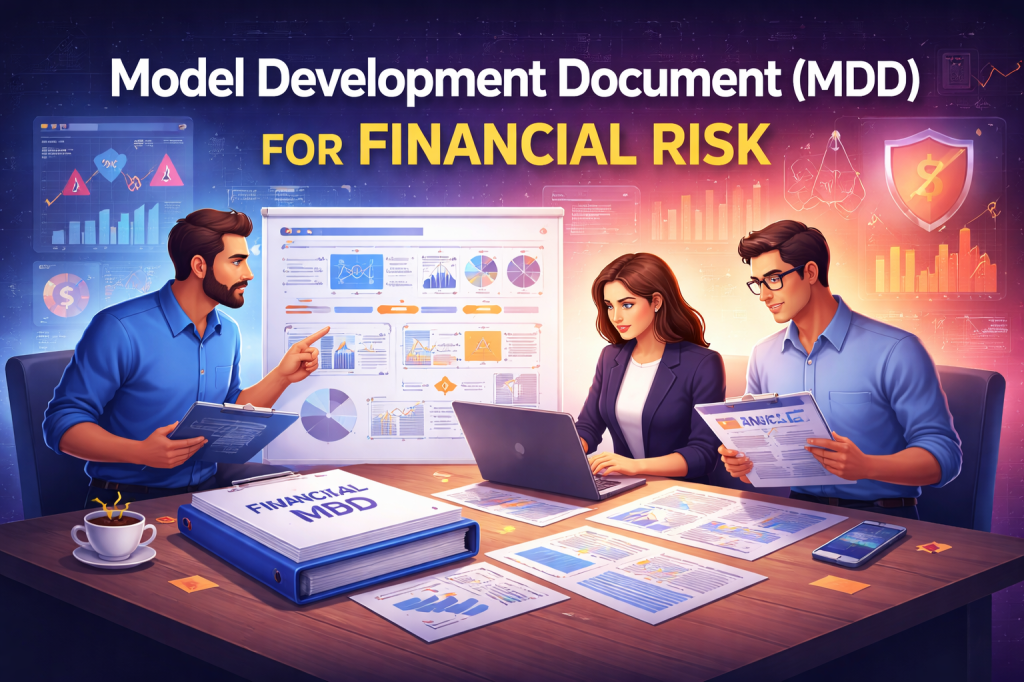
In modern financial institutions, quantitative models drive critical decisions—from credit approvals to market risk assessment and fraud detection. However, with increasing reliance on models comes model risk—the risk of incorrect decisions due to flawed or misused models.
To mitigate this, organizations implement Model Risk Management (MRM) frameworks. A key pillar of MRM is the Model Development Document (MDD)—a comprehensive document that explains how a model is built, why it exists, and how it should be used.
This article explores the structure, purpose, and best practices for creating an effective MDD, along with real-world examples.
What is a Model Development Document (MDD)?
A Model Development Document (MDD) is a formal, detailed record of the entire lifecycle of a model—from conceptualization to implementation.
Key Objectives:
- Ensure transparency of model design
- Enable independent validation
- Support regulatory compliance
- Provide auditability
- Facilitate model maintenance and updates
Why is MDD Important in MRM?
In financial risk management, poor model documentation can lead to:
- Misinterpretation of model outputs
- Incorrect implementation
- Regulatory penalties
- Financial losses
MDD helps to:
- Standardize model development practices
- Improve communication between stakeholders (developers, validators, auditors)
- Reduce dependency on individual developers
- Ensure models are fit-for-purpose
Key Components of a Model Development Document
A robust MDD typically includes the following sections:
1. Model Overview
Purpose: Provide a high-level summary of the model.
Includes:
- Model name
- Business purpose
- Model type (e.g., regression, machine learning)
- Target users
Example:
A Probability of Default (PD) model developed to estimate the likelihood of borrower default for retail loans.
2. Business Context and Objectives
Purpose: Explain why the model exists.
Includes:
- Business problem
- Use cases
- Decision-making impact
Example:
The model supports credit risk assessment during loan underwriting, influencing approval decisions and pricing.
3. Data Description
Purpose: Document the data used in model development.
Includes:
- Data sources
- Time period
- Data quality checks
- Preprocessing steps
Example:
- Source: Internal loan database
- Period: 2018–2023
- Variables: Income, credit score, loan amount
- Missing values handled using median imputation
4. Methodology and Model Design
Purpose: Describe how the model is built.
Includes:
- Model selection rationale
- Algorithms used
- Assumptions
- Feature engineering techniques
Example:
Logistic regression was selected due to interpretability and regulatory preference. Variables were transformed using Weight of Evidence (WoE).
5. Model Development Process
Purpose: Explain step-by-step development.
Includes:
- Training and testing split
- Variable selection process
- Hyperparameter tuning
- Tools used (Python, SAS, R)
Example:
- 70% training / 30% testing split
- Stepwise selection used for feature reduction
6. Model Performance Metrics
Purpose: Demonstrate model effectiveness.
Includes:
- Accuracy metrics (AUC, Gini, RMSE)
- Benchmark comparisons
- Backtesting results
Example:
- AUC: 0.78
- Gini: 0.56
- KS statistic: 0.42
7. Model Assumptions and Limitations
Purpose: Highlight risks and constraints.
Includes:
- Key assumptions
- Known weaknesses
- Situations where model may fail
Example:
The model assumes stable economic conditions and may underperform during economic downturns.
8. Model Validation Summary
Purpose: Provide an overview of validation findings.
Includes:
- Validation approach
- Key issues identified
- Remediation actions
Example:
Validation flagged multicollinearity among variables; resolved by removing correlated features.
9. Implementation Details
Purpose: Explain how the model is deployed.
Includes:
- System integration
- Code references
- Data pipelines
- Frequency of execution
Example:
Model deployed in production using Python API, executed daily during loan processing.
10. Model Governance and Controls
Purpose: Ensure proper oversight.
Includes:
- Model ownership
- Approval process
- Version control
- Change management
11. Monitoring and Maintenance Plan
Purpose: Ensure ongoing performance.
Includes:
- Performance tracking metrics
- Drift detection
- Recalibration frequency
Example:
Model performance monitored monthly; recalibration triggered if AUC drops below 0.70.
Practical Example: Credit Risk Model MDD
Let’s walk through a simplified example:
Scenario:
A bank develops a Credit Default Prediction Model
Key Highlights in MDD:
- Objective: Predict probability of default
- Data: Customer demographics + credit history
- Model: Logistic regression
- Performance: AUC = 0.80
- Limitation: Limited data on new customers
- Monitoring: Quarterly validation
Common Challenges in Preparing MDD
- Incomplete documentation
- Lack of standardization
- Overly technical language
- Missing assumptions or limitations
- Poor version control
Best Practices for Writing an Effective MDD
1. Be Clear and Structured
Avoid unnecessary complexity—write for both technical and non-technical audiences.
2. Ensure Completeness
Cover all lifecycle stages of the model.
3. Maintain Consistency
Use templates and standardized formats across the organization.
4. Focus on Explainability
Especially important for regulatory models (e.g., credit risk).
5. Keep It Updated
An outdated MDD is as risky as no documentation.
Regulatory Perspective
Regulators expect strong documentation under frameworks like:
- SR 11-7 (Model Risk Management guidance)
- Basel guidelines for risk models
MDD plays a critical role in demonstrating:
- Model transparency
- Validation readiness
- Risk control effectiveness
Sample Model Development Document (MDD) – Credit Risk Model
Model Development Document (MDD)
Enterprise Credit Risk Model Suite (PD, LGD, EAD) – Regulatory Compliant
1. Document Control & Governance
Model Name: Enterprise Credit Risk Model Suite
Model ID: CR-IFRS9-ML-001
Version: 2.0 (Regulatory Enhanced)
Effective Date: January 2026
Regulatory Frameworks: Basel II/III (IRB), SR 11-7, IFRS 9
Approval:
- Model Development: Risk Analytics Team
- Independent Validation: Model Risk Management (MRM)
- Final Approval: Model Risk Committee (MRC)
Change Log:
- v2.0: Added ML models, IFRS 9 alignment, enhanced governance
2. Regulatory Context (Basel & SR 11-7 Alignment)
This model suite complies with:
Basel Requirements (IRB Approach)
- Risk parameter estimation: PD, LGD, EAD
- Long-run average default rates
- Downturn LGD adjustments
- Use test compliance (model embedded in decision-making)
SR 11-7 Principles
- Model is conceptually sound and well-documented
- Ongoing monitoring and outcomes analysis implemented
- Independent validation ensures objectivity
- Governance framework ensures accountability
IFRS 9 Requirements
- Forward-looking Expected Credit Loss (ECL)
- Stage classification (Stage 1, 2, 3)
- Lifetime PD estimation
3. Model Overview
This document covers a hybrid modeling framework:
| Component | Model Type |
|---|---|
| PD Model | Logistic Regression + XGBoost |
| LGD Model | Gradient Boosting |
| EAD Model | Regression Model |
Purpose:
- Credit risk quantification
- Regulatory capital calculation
- Financial reporting (ECL under IFRS 9)
4. Business Use & Use Test (Basel Compliance)
The model is actively used in:
- Loan underwriting decisions
- Risk-based pricing
- Capital adequacy calculation
- IFRS 9 provisioning
Use Test Evidence:
- Integrated into loan origination system
- Used by credit officers for decision-making
5. Data Description & Governance
Sources:
- Core banking systems
- Credit bureau data
- Macroeconomic datasets (GDP, inflation)
Time Horizon: 2015–2025
Data Governance Controls:
- Data lineage documented
- Data quality checks (completeness, accuracy)
- Audit trails maintained
Preprocessing:
- Missing value imputation
- Outlier treatment
- Feature scaling (for ML models)
6. Methodology & Model Design
6.1 Traditional Model (Logistic Regression)
- Used for regulatory transparency
- WoE transformation applied
6.2 Machine Learning Model (XGBoost)
Rationale:
- Captures non-linear relationships
- Higher predictive power
Controls (SR 11-7 Compliance):
- Feature importance analysis
- SHAP values for explainability
- Benchmarking against simpler models
6.3 IFRS 9 PD Model
- 12-month PD for Stage 1
- Lifetime PD for Stage 2 & 3
- Macroeconomic overlays applied
7. Model Development Process
Segmentation:
- Retail vs SME portfolios
Training Approach:
- Train/Test split: 70/30
- Cross-validation for ML models
Hyperparameter Tuning (XGBoost):
- Grid search optimization
Model Selection Criteria:
- Predictive performance
- Stability
- Interpretability
8. Model Performance & Benchmarking
| Metric | Logistic | XGBoost |
|---|---|---|
| AUC | 0.78 | 0.86 |
| Gini | 0.56 | 0.72 |
| KS | 0.42 | 0.55 |
Conclusion:
- XGBoost improves performance
- Logistic retained for regulatory explainability
9. Model Risk Assessment (SR 11-7)
Key Risks:
- Model overfitting (ML models)
- Data drift
- Macroeconomic sensitivity
Mitigation:
- Regular backtesting
- Challenger models
- Conservative overrides
10. Validation Framework
Independent Validation Includes:
- Conceptual soundness review
- Process verification
- Outcomes analysis
ML-Specific Validation:
- Stability testing
- Sensitivity analysis
- Explainability validation (SHAP)
Validation Outcome:
Approved with minor recommendations
11. Implementation & IT Controls
Deployment:
- Cloud-based infrastructure (AWS)
- API integration with core systems
Controls:
- Access control
- Version control (Git)
- Logging & audit trails
12. Monitoring & Ongoing Performance
Metrics Monitored:
- AUC, KS
- Population Stability Index (PSI)
- Characteristic Stability Index (CSI)
Thresholds:
- PSI > 0.25 → Model review
- Performance drop > 10% → Recalibration
Frequency: Monthly
13. IFRS 9 – Expected Credit Loss (ECL)
ECL Formula:
ECL = PD × LGD × EAD
Enhancements:
- Forward-looking macroeconomic scenarios
- Probability-weighted outcomes
14. Model Limitations
- ML models less interpretable
- Dependence on macroeconomic forecasts
- Data limitations for new customers
15. Model Governance Framework
Three Lines of Defense:
- Model Development (1st line)
- Model Validation (2nd line)
- Internal Audit (3rd line)
Committees:
- Model Risk Committee (MRC)
- Credit Risk Committee
16. Appendices
Appendix A: Variable List
Appendix B: Model Parameters
Appendix C: Validation Reports
Appendix D: SHAP Explainability Outputs
Appendix B: Sample XGBoost Features
| Feature | Importance |
|---|---|
| Credit Score | High |
| Income | Medium |
| Delinquency | High |
End of Regulatory-Compliant MDD
Conclusion
The Model Development Document (MDD) is more than just documentation—it is the backbone of effective Model Risk Management (MRM). A well-prepared MDD ensures that models are transparent, reliable, and compliant with regulatory expectations.
In an era where financial institutions increasingly rely on complex models, investing in high-quality MDDs is not optional—it is essential.
Quick Reference: Simple MDD Template
- Model Overview
- Business Context
- Data Description
- Methodology
- Development Process
- Performance Metrics
- Assumptions & Limitations
- Validation Summary
- Implementation Details
- Governance
- Monitoring Plan


 time2anlytics.com
Leave a comment