
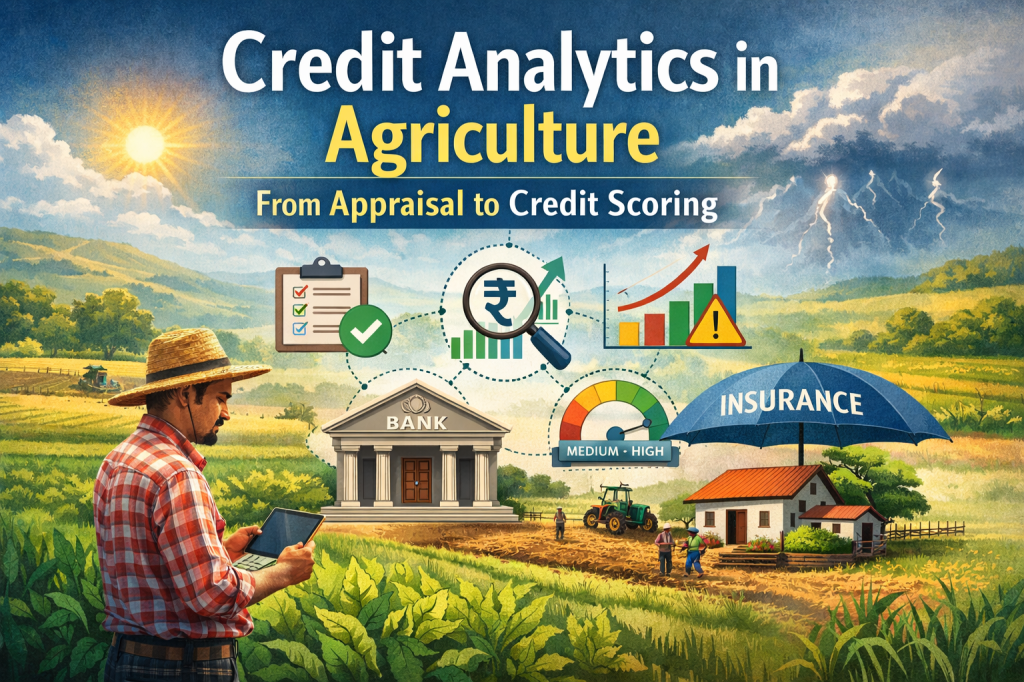
A Practical, Data-Driven Perspective
Agricultural lending is fundamentally different from retail or corporate lending. Unlike salaried borrowers or large firms, farmers and Farmer Producer Organizations (FPOs) operate under high uncertainty—weather shocks, price volatility, biological risks, and policy interventions.
This article explains four core pillars of agricultural credit analytics using realistic examples and decision logic:
- Credit appraisal process in agriculture
- Assessment of repayment capacity and collateral
- Credit risk factors in farm and FPO lending
- Introduction to credit scoring models
1. Credit Appraisal Process in Agriculture
What is Credit Appraisal?
Credit appraisal is the systematic evaluation of a borrower’s ability and willingness to repay a loan. In agriculture, this process goes beyond income statements—it requires understanding crops, seasons, risks, and local realities.
Key Stages of Agricultural Credit Appraisal
1️⃣ Borrower Profiling
- Farmer / tenant / FPO
- Landholding size and type
- Cropping pattern
- Past borrowing history
Example – Farmer Case
A small coffee grower owns 3 acres, grows coffee as the main crop, and intercrops pepper. Income is seasonal and price-sensitive.
Insight: Even before numbers, the lender understands income timing and variability.
2️⃣ Purpose of Loan
Agricultural loans are purpose-specific:
- Crop loans (inputs)
- Term loans (irrigation, plantation, machinery)
- Working capital for FPOs
Why this matters:
Different purposes carry different risk profiles and repayment structures.
3️⃣ Technical & Economic Feasibility
The lender evaluates:
- Expected yield
- Input requirements
- Market prices
- Cost–benefit ratio
Example
If cardamom prices are volatile but long-term demand is strong, the lender may structure:
- Lower EMI in early years
- Insurance-backed lending
4️⃣ Risk Identification
Before approval, lenders assess:
- Weather risk
- Price risk
- Operational risk
- Credit history
👉 This step directly feeds into risk analytics and scoring models.
2. Assessment of Repayment Capacity and Collateral
A. Repayment Capacity: The Core of Credit Analytics
In agriculture, repayment does not happen monthly like salaried loans. It depends on harvest cycles and market realization.
Key Components of Repayment Assessment
1️⃣ Farm Cash Flow Analysis
- Expected revenue = Yield × Price × Area
- Expenses = Inputs + labor + irrigation + maintenance
- Net surplus determines repayment ability
Example – Paddy Farmer
- Annual revenue: ₹2.2 lakhs
- Input & household expenses: ₹1.6 lakhs
- Net surplus: ₹60,000
👉 Loan EMI must comfortably fit within this surplus.
2️⃣ Stress Testing (Very Important)
Good appraisal checks what happens if things go wrong:
- Yield falls by 20%
- Price drops by 15%
- Input costs increase
Insight:
If repayment collapses under mild stress, the loan is inherently risky.
B. Collateral Assessment
Traditional agricultural lending relies heavily on collateral, but this has limitations.
Types of Collateral
- Agricultural land
- Farm equipment
- Warehouse receipts
- Personal or group guarantees
Challenges
- Small & tenant farmers lack clear land titles
- Land value ≠ repayment capacity
- Collateral does not reduce climate risk
👉 Hence, modern agri-lending is slowly shifting from collateral-based to cash-flow-based assessment.
3. Credit Risk Factors in Farm and FPO Lending
A. Credit Risk Factors in Individual Farm Lending
1️⃣ Production Risk
- Weather variability
- Pest and disease
- Soil degradation
Example:
Two farmers with identical land sizes may have very different yields due to irrigation access.
2️⃣ Price Risk
- Commodity price fluctuations
- Market access
- Dependence on intermediaries
Example:
Coffee prices fluctuate globally, directly affecting repayment ability.
3️⃣ Behavioral Risk
- Past defaults
- Loan diversion
- Financial discipline
4️⃣ Policy Risk
- Changes in MSP
- Export bans
- Subsidy withdrawal
B. Credit Risk Factors in FPO Lending
FPO lending is enterprise lending, not individual farming.
Key Risk Dimensions
1️⃣ Governance Risk
- Board effectiveness
- Professional management
- Transparency
2️⃣ Member Risk
- Side-selling by farmers
- Low member participation
3️⃣ Operational Risk
- Poor inventory management
- Inefficient procurement
4️⃣ Market Risk
- Buyer concentration
- Contract dependency
Example:
An FPO with strong revenue but weak governance may be riskier than a smaller, well-managed FPO.
4. Introduction to Credit Scoring Models
What is Credit Scoring?
Credit scoring converts qualitative and quantitative borrower characteristics into a numerical risk score.
Instead of subjective judgment alone, lenders use structured scoring to:
- Rank borrowers
- Standardize decisions
- Price risk appropriately
Types of Credit Scoring Models in Agriculture
1️⃣ Rule-Based Scorecards
Simple and transparent.
Typical Factors
- Landholding size
- Crop diversification
- Past repayment history
- Yield stability
- Weather exposure
Example
- Score ≥ 75 → Low risk
- Score 50–75 → Medium risk
- Score < 50 → High risk
📌 Common in banks and NBFCs.
2️⃣ Statistical Models
Use historical data to estimate:
- Probability of Default (PD)
- Expected Loss (EL)
Techniques include:
- Logistic regression
- Decision trees
📌 Require reliable data, often limited in agriculture.
3️⃣ Alternative Data–Driven Models (Agri-FinTech)
Use:
- Satellite imagery
- Weather data
- Transaction history
Advantages
- Works for tenant farmers
- Faster decisions
Limitations
- Data bias
- Explainability issues
- Regulatory concerns
Important Caution
Credit scores support decisions, they do not replace judgment.
In agriculture:
“Bad weather can make a good borrower look bad.”
Conclusion: Why Analytics Matters in Agricultural Credit
Agricultural credit is no longer just about land and subsidies.
It is about:
- Understanding risk
- Designing resilient loan structures
- Integrating insurance and analytics
- Supporting sustainable farm livelihoods
For students, practitioners, and policymakers, mastering agricultural credit analytics means making better decisions in an uncertain world.
📚 References
- Reserve Bank of India. (2023). Master circular on lending to priority sector. Mumbai, India: RBI.
- Reserve Bank of India. (2019). Report of the internal working group on agricultural credit. Mumbai, India: RBI.
- National Bank for Agriculture and Rural Development. (2018). Manual on agricultural credit. Mumbai, India: NABARD.
- National Bank for Agriculture and Rural Development. (2020). Financing farmer producer organizations: Issues and challenges. Mumbai, India: NABARD.
- Ministry of Agriculture and Farmers Welfare. (2022). Operational guidelines for Pradhan Mantri Fasal Bima Yojana (PMFBY). New Delhi, India: Government of India.
- Agricultural Insurance Company of India. (2021). Weather-based and yield-based crop insurance operational guidelines. New Delhi, India: AIC.
- Food and Agriculture Organization. (2015). Agricultural finance revisited: Why agriculture remains underserved by financial institutions. Rome, Italy: FAO.
- World Bank. (2016). Agricultural finance and credit infrastructure: A global perspective. Washington, DC: World Bank.
- World Bank. (2019). Big data, analytics, and alternative data in agricultural credit. Washington, DC: World Bank.
- Asian Development Bank. (2017). Innovative financing models for agriculture and rural development. Manila, Philippines: ADB.
- International Fund for Agricultural Development. (2018). Rural finance, risk management, and smallholder resilience. Rome, Italy: IFAD.
- Organisation for Economic Co-operation and Development. (2011). Managing risk in agriculture: A holistic approach. Paris, France: OECD Publishing.
- Basel Committee on Banking Supervision. (2006). International convergence of capital measurement and capital standards: A revised framework. Basel, Switzerland: Bank for International Settlements.
- Consultative Group to Assist the Poor. (2019). Digital credit scoring and data analytics in agriculture. Washington, DC: CGAP.
- Gonzalez-Vega, C., & Meyer, R. L. (2002). The demand for agricultural finance: Structured finance for agriculture. Columbus, OH: Ohio State University.
- Armendáriz, B., & Morduch, J. (2010). The economics of microfinance (2nd ed.). Cambridge, MA: MIT Press.
- Barry, P. J., & Ellinger, P. N. (2012). Financial management in agriculture (7th ed.). Upper Saddle River, NJ: Pearson Education.






 time2anlytics.com
Leave a comment