
1. Introduction
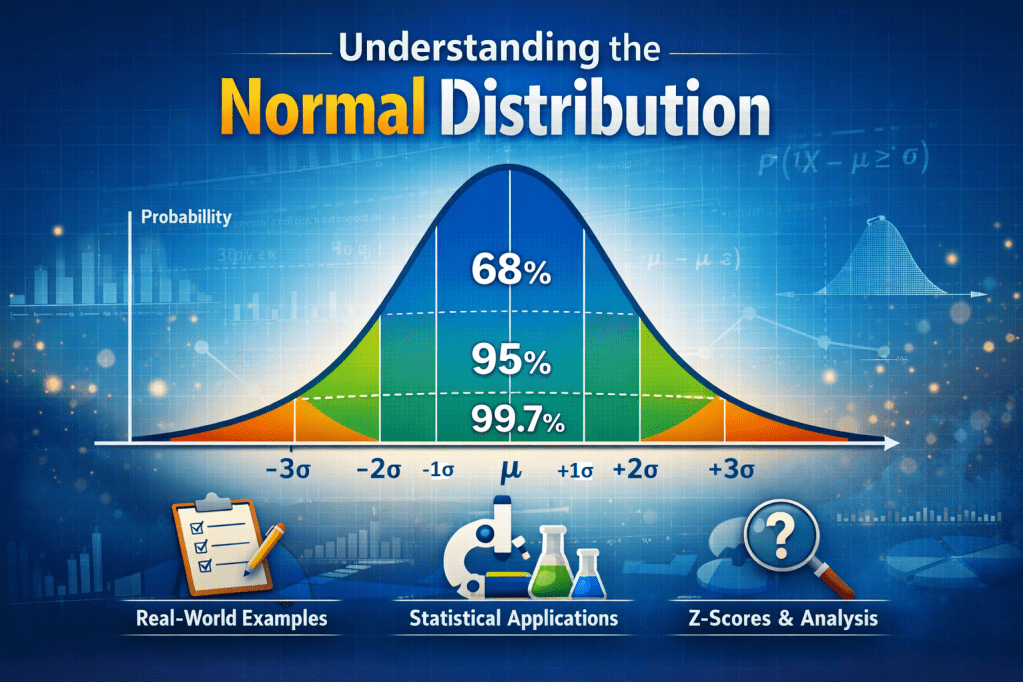
In statistics, one of the most important and widely used concepts is the normal distribution, also known as the Gaussian distribution. It plays a central role in data analysis, probability theory, and inferential statistics because many real-world phenomena approximately follow this distribution.
From students’ test scores to measurement errors and biological traits like height and weight, the normal distribution provides a powerful framework to understand variability and uncertainty.
2. What is Normal Distribution?
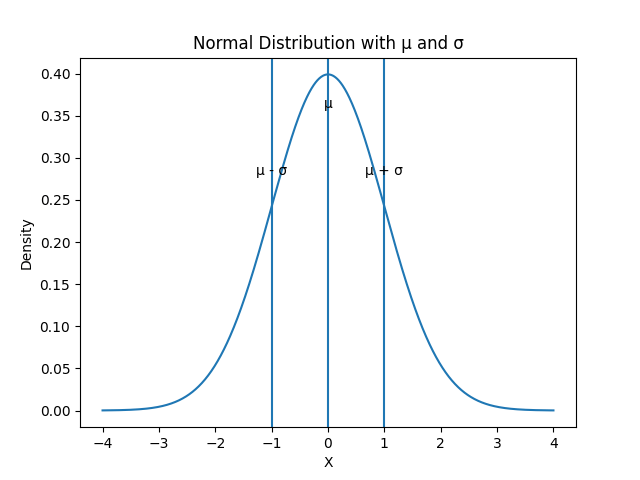
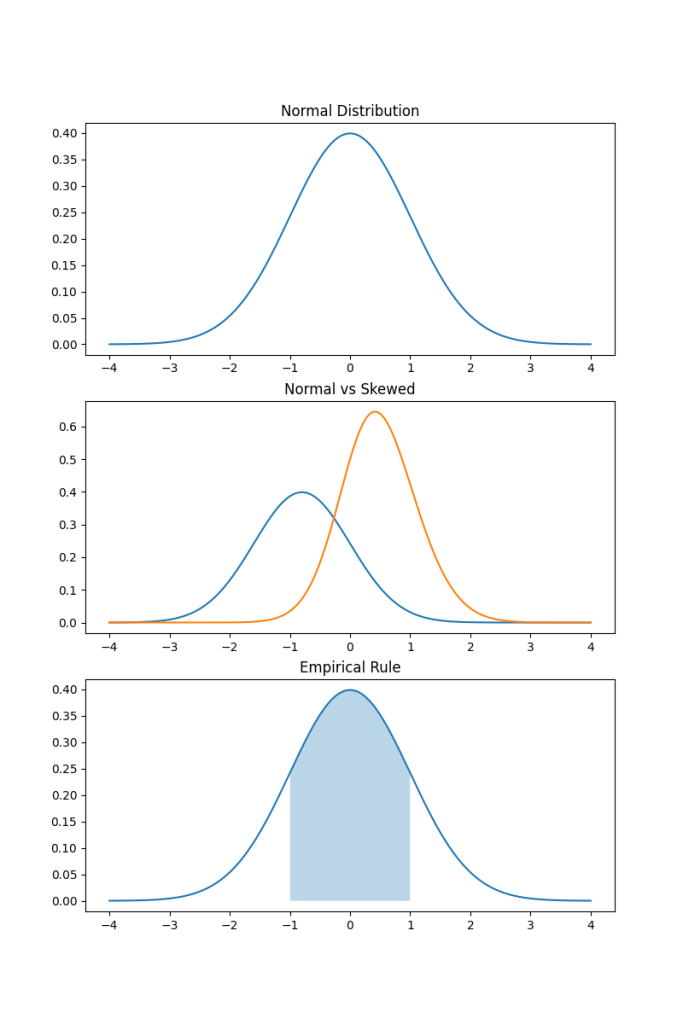
A normal distribution is a continuous probability distribution that is symmetric about its mean. It is characterized by a bell-shaped curve where:
- Most observations cluster around the central peak (mean)
- Probabilities decrease as we move away from the mean
- The distribution is perfectly symmetrical
Mathematically, it is defined by two parameters:
- Mean (μ) → Center of the distribution
- Standard Deviation (σ) → Spread or dispersion of the data
3. Mathematical Representation
The probability density function (PDF) of a normal distribution is:
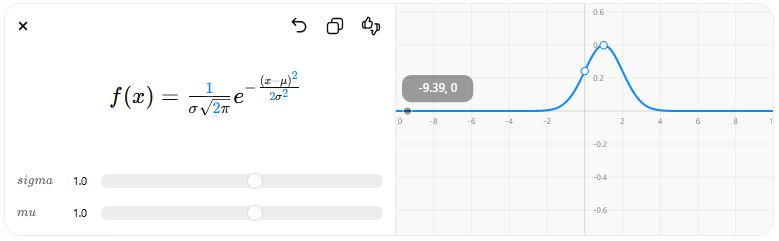
Where:
- x = random variable
- μ = mean
- σ = standard deviation
This formula defines the shape of the bell curve.
4. Key Properties of Normal Distribution
✔️ Symmetry
- The distribution is symmetric around the mean.
- Mean = Median = Mode
✔️ Bell-Shaped Curve
- Highest point at the mean
- Tails extend infinitely in both directions
✔️ Total Area = 1
- The total probability under the curve equals 1
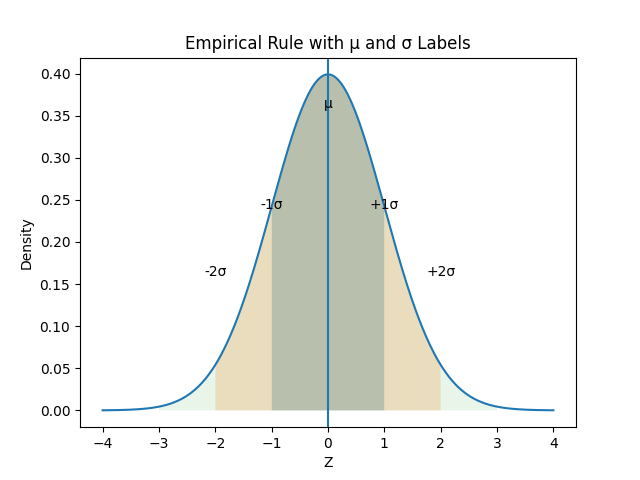
✔️ Empirical Rule (68-95-99.7 Rule)

This means:
- 68% of data lies within ±1σ
- 95% within ±2σ
- 99.7% within ±3σ
5. Standard Normal Distribution (Z-Distribution)
When a normal distribution is standardized, it becomes a standard normal distribution with:
- Mean = 0
- Standard deviation = 1
The transformation is:
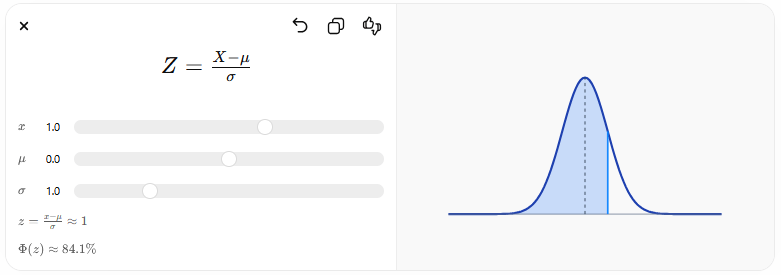
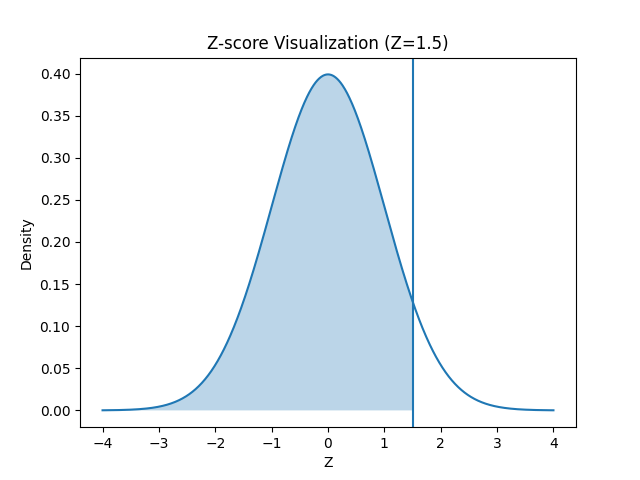
This conversion allows us to use Z-tables to find probabilities.
6. Real-World Examples
📌 Example 1: Students’ Exam Scores
Suppose exam scores are normally distributed:
- Mean (μ) = 70
- Standard deviation (σ) = 10
- About 68% of students score between 60 and 80
- About 95% score between 50 and 90
📌 Example 2: Human Height
Heights of adult males in a population often follow a normal distribution:
- Mean = 170 cm
- Standard deviation = 7 cm
Most individuals fall within:
- 163–177 cm (±1σ)
📌 Example 3: Measurement Errors
In scientific experiments:
- Small errors occur frequently
- Large errors are rare
This pattern forms a normal distribution.
7. Applications of Normal Distribution
🎓 1. Education & Testing
- Grading systems
- Standardized tests (e.g., percentile ranks)
💼 2. Business & Management
- Demand forecasting
- Quality control (Six Sigma)
🌾 3. Agriculture Research
- Crop yield variability
- Experimental error analysis
🧪 4. Scientific Research
- Sampling distributions
- Hypothesis testing
💰 5. Finance
- Risk modeling
- Asset return analysis (approximation)
8. Why is Normal Distribution Important?
🔹 Central Limit Theorem (CLT)
One of the key reasons for its importance is the Central Limit Theorem, which states:
The sampling distribution of the mean tends to be normal, regardless of the population distribution (for large sample sizes).
This makes the normal distribution foundational for:
- Statistical inference
- Confidence intervals
- Hypothesis testing
9. Limitations of Normal Distribution
Despite its usefulness, it has some limitations:
- Not suitable for skewed data
- Cannot model extreme outliers effectively
- Assumes infinite range (−∞ to +∞)
- Real-world data may have fat tails (e.g., financial crashes)
10. Visual Interpretation (Conceptual)
A normal curve:
- Peaks at the mean
- Tapers symmetrically
- Has inflection points at ±1σ
11. Conclusion
The normal distribution is a cornerstone of statistics due to its simplicity, mathematical elegance, and wide applicability. Whether in agriculture, management, or scientific research, understanding this distribution helps in making informed decisions based on data.
Mastering normal distribution also opens the door to advanced statistical techniques such as regression analysis, hypothesis testing, and machine learning models.
📚 References
- Montgomery, D. C., & Runger, G. C. (2014). Applied Statistics and Probability for Engineers
- Gupta, S. C., & Kapoor, V. K. (2020). Fundamentals of Mathematical Statistics
- Spiegel, M. R. (2009). Schaum’s Outline of Statistics
- Walpole, R. E. et al. (2012). Probability and Statistics for Engineers and Scientists
- Khan Academy – Normal Distribution Tutorials
- NIST/SEMATECH e-Handbook of Statistical Methods





 time2anlytics.com
Leave a comment