
Introduction
Agriculture today is no longer just about plows and pastures; it’s about precision, prediction, and performance. The global agri-food system is under unprecedented pressure. Population growth, climate volatility, resource degradation, price uncertainty, and market inefficiencies are creating a complex web of challenges. At the same time, we are witnessing a digital revolution sweeping through every sector—including agriculture.
Agricultural Analytics has emerged at the confluence of agriculture and data science. It enables stakeholders—from smallholder farmers to large agribusinesses—to make evidence-based decisions throughout the agricultural value chain.
Far from being a buzzword, agricultural analytics is a transformative approach that can redefine how we cultivate, manage, trade, and govern food systems. Let’s dive deeper into what it means, how it works, and why it’s a cornerstone of 21st-century agriculture.
This blog explores the concept of agricultural analytics, its types, applications, tools, challenges, and future potential.
What is Agricultural Analytics?
Agricultural Analytics refers to the application of data science, statistical models, AI/ML techniques, and geospatial tools to collect, process, analyze, and interpret data across the agriculture lifecycle—soil to shelf. Its goal is to optimize agricultural productivity, minimize risk, and enhance sustainability across the entire agricultural value chain.
It transforms raw agricultural data into actionable insights to support decision-making in areas such as:
- Crop planning
- Resource optimization
- Risk mitigation
- Market forecasting
- Policy formulation
In short, agricultural analytics makes farming smarter, supply chains stronger, and agriculture more resilient.
Evolution of Agricultural Analytics
| Phase | Characteristics |
|---|---|
| Traditional Agriculture | Experience and observation-based decisions, manual data recording, reactive problem-solving |
| Green Revolution Era | High-input, high-output agriculture with minimal data focus |
| Precision Agriculture | Use of GPS, sensors, and field-level data for input optimization |
| Digital Agriculture & Analytics | Real-time data integration from satellites, IoT, mobile apps, and AI for predictive and prescriptive analytics |
Why Agricultural Analytics Matters
🌱 Optimize Yield and Resource Use
🌧️ Predict Weather and Plan Operations
💹 Improve Market Access and Pricing Decisions
🐛 Detect Pests and Diseases Early
🛰️ Monitor Crops and Soil Health Remotely
📉 Reduce Wastage and Post-Harvest Losses
Types of Agricultural Analytics
1. Descriptive Analytics
- Answers: What happened?
- Examples: Crop yield reports, soil health dashboards, rainfall history
2. Diagnostic Analytics
- Answers: Why did it happen?
- Examples: Identifying reasons for pest outbreaks or yield decline using root cause analysis
3. Predictive Analytics
- Answers: What is likely to happen?
- Examples: Predicting crop yield, price volatility, or disease risk using historical and real-time data
4. Prescriptive Analytics
- Answers: What should be done?
- Examples: Recommending fertilizer dosage, irrigation scheduling, or marketing strategies using AI/ML models
| Type | Purpose | Examples |
|---|---|---|
| Descriptive Analytics | Understand past and current performance | Yield history, rainfall trends |
| Diagnostic Analytics | Identify reasons for patterns or anomalies | Low yield due to pest or poor soil nutrition |
| Predictive Analytics | Forecast future outcomes | Crop yield forecasting, market price prediction |
| Prescriptive Analytics | Recommend actions | Best sowing date, fertilizer application strategy |
Core Data Sources in Agricultural Analytics
| Source | Data Type |
|---|---|
| Satellites & Drones | Remote sensing imagery (NDVI, vegetation index) |
| IoT Devices/Sensors | Soil moisture, temperature, pH, weather |
| Farm Records | Sowing date, harvest quantity, pesticide use |
| Market Data | Commodity prices, demand trends |
| Government/Extension Data | Policy updates, subsidies, agronomic advisories |
| Climate Models | Weather and risk forecasts |
Key Technologies Driving Agricultural Analytics
🌐 GIS, Geospatial Tools and Remote Sensing
- For crop classification, area estimation, and yield forecasting, Mapping and zoning based on soil, water, and crop patterns
🧠 Artificial Intelligence & Machine Learning
- To model complex phenomena like crop disease spread or price prediction
📱 Mobile and Cloud Platforms
- For real-time farmer advisories, input recommendations, and data capture
🌡️ IoT and Precision Agriculture
- Enables sensor-based decision-making for water, fertilizer, and pest control
🧮 Statistical Modelling & Simulation
- For yield prediction, economic forecasting, and risk modeling
Applications of Agricultural Analytics
🌾 On-Farm Decision Making
- Precision Agriculture: Optimize input use based on soil and crop health
- Sowing Windows: AI-based sowing date advisories (e.g., Microsoft-Rainfed Farming project in India)
- Pest and Disease Surveillance: Image-based diagnosis using mobile apps
- Irrigation Scheduling: Sensor-based water stress analytics
🚜 Agribusiness & Supply Chain Optimization
- Demand Forecasting: Predicting consumer demand and adjusting procurement
- Post-Harvest Loss Minimization: Cold chain route optimization
- Traceability: Ensuring product integrity and certifications using blockchain-linked analytics
💹 Financial Services and Agri-Insurance
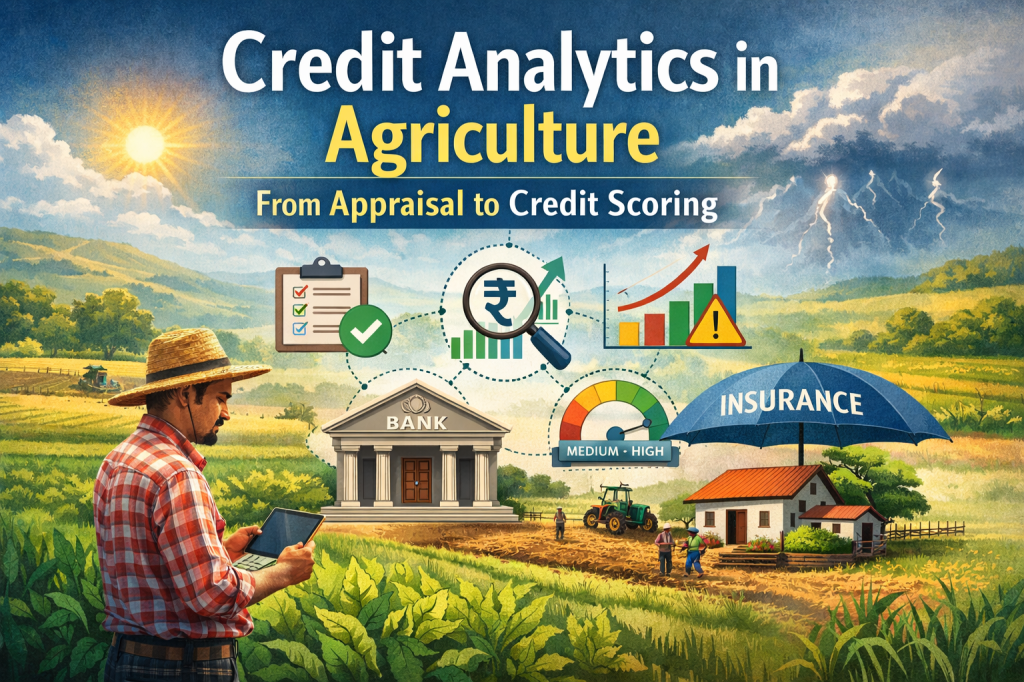
- Credit Scoring Models: Predicting repayment risk using farm-level and satellite data
- Weather-Based Insurance: Analytics for trigger point modeling and claim validation
- MSME & FPO Lending: Digitally profiling Farmer Producer Organizations (FPOs) using analytics
🏛️ Policy and Governance
- Crop Estimation Models: Used by ministries for procurement and food security planning
- Climate Resilience Planning: Agro-climatic zone planning using long-term analytics
- Subsidy Targeting: Aadhaar-linked data analytics for better scheme delivery
Agricultural Analytics in India: Initiatives and Use Cases
India, with its diverse agro-climatic zones and 120+ million farmers, presents a fertile ground for agricultural analytics.
🧪 Key Initiatives
- Digital Agriculture Mission (2021–2025) – Promotes use of AI, GIS, IoT, drones, and data platforms
- Fasal Bima Yojana Analytics Engine – Integrates remote sensing with claims and risk analysis
- AgriStack – A proposed digital ecosystem for agriculture, integrating farmer IDs, land records, and inputs
📌 Startups and Platforms
- CropIn: AI-based crop monitoring and advisory
- NinjaCart: Demand-driven agri-logistics optimization
- SatSure: Satellite analytics for banks and insurers
- Gramener: Visual data stories for agri-analytics
Real-World Examples
1. IBM Watson Decision Platform for Agriculture
Combines AI, IoT, and satellite data to help farmers make decisions on planting, harvesting, and pest control.
2. CropIn Technology (India)
Offers AI-powered platforms for farm-to-fork visibility and traceability using predictive analytics.
3. ICRISAT’s Data-Driven Farmer Advisory System
Uses climate and soil data to issue personalized recommendations to smallholder farmers in India and Africa.
Benefits of Agricultural Analytics
📈 Higher Productivity and Profitability
💧 Efficient Resource Management
🛡️ Improved Risk Mitigation
🌿 Sustainable Farming Practices
🔍 Transparent and Traceable Value Chains
| Benefit | Impact |
|---|---|
| Increased Productivity | Better sowing, input, and irrigation timing |
| Cost Reduction | Efficient resource utilization |
| Improved Resilience | Early warnings, climate-adapted planning |
| Market Access | Price transparency and demand alignment |
| Farmer Empowerment | Access to personalized advisories and credit |
Challenges in Implementing Agricultural Analytics
| Challenge | Description |
|---|---|
| Data Gaps | Incomplete, unstructured, or non-digital data from smallholders |
| Digital Divide | Limited access to devices, internet, and training |
| High Cost of Technology | Drones, IoT, and software are expensive for small/marginal farmers |
| Privacy and Data Ownership | Concerns over who owns and uses farmer data |
| Scalability | Difficulty in scaling pilot projects to large geographies |
| Digital Literacy | Farmers may lack awareness or training to use tools effectively |
Future Outlook and Trends
🔮 Emerging Trends
- AI for Predictive Breeding: Using genomics and analytics for faster crop improvement
- Agro-Ecosystem Modeling: Simulating entire landscapes for policy and conservation
- Edge Computing in Agri-IoT: Real-time analytics at the source (e.g., field sensors)
- Carbon Farming Analytics: Measuring and verifying carbon sequestration in agriculture
- Interoperable Agri-Data Platforms: Linked agri-data sharing protocols (e.g., FAO’s AGROVOC, GODAN)
🌍 Vision for 2030
“A digitally integrated, analytically driven, inclusive agri-ecosystem where farmers and institutions make better decisions for profitability, sustainability, and food security.”
Conclusion
Agricultural Analytics is revolutionizing the way we grow, distribute, and consume food. It is helping transition from traditional farming to smart agriculture, where data guides every step of the agri value chain. For a country like India and many developing economies where smallholder farming dominates, analytics can be a powerful tool for ensuring food security, improving incomes, and promoting climate-resilient agriculture.
As we move toward the UN’s Sustainable Development Goals (SDGs), particularly Zero Hunger (SDG 2) and Climate Action (SDG 13), the intelligent use of agricultural data will be pivotal.
The future of farming is data-driven—and Agricultural Analytics is the plow that will till this new frontier.
References
- FAO. (2019). Digital technologies in agriculture and rural areas. http://www.fao.org/3/ca4887en/ca4887en.pdf
- IBM Agriculture. https://www.ibm.com/watsonx/agriculture
- CropIn Technology. https://www.cropin.com
- ICRISAT. (2020). Data-Driven Agriculture: Improving Farmer Decision-Making in the Face of Climate Change.
- McKinsey & Company. (2020). Agriculture’s connected future: How technology can yield new growth. https://www.mckinsey.com/industries/agriculture/our-insights
- World Bank. (2021). Harnessing the Power of Digital Agriculture. https://www.worldbank.org/en/topic/agriculture/publication/harnessing-the-power-of-digital-agriculture
- Ministry of Agriculture & Farmers Welfare, Government of India. https://agricoop.gov.in
- World Economic Forum. (2022). Transforming Agriculture through Data.
- Government of India. Digital Agriculture Mission 2021–2025 White Paper.


 time2anlytics.com
Leave a comment