
Author: Dr. Sindhuja C. V., Ph.D (IISc), Senior Research Consultant
Introduction
Field assessments in research demand strong qualitative methods to capture diverse perspectives, experiences, and insights from participants. Among these methods, Focus Group Discussions (FGDs) have emerged as a powerful tool for collecting qualitative data in mixed-method research. Whether used alone or alongside surveys and case studies, FGDs deliver rich, detailed information that helps researchers tackle complex social, economic, and policy-related issues. They are particularly valuable in mixed-method research, where qualitative and quantitative data work together to provide a comprehensive understanding of a topic. FGDs are not only cost-effective but also highly adaptable, making them suitable for a wide range of research settings, from academic studies to real-world applications in development and business.
What Are Focus Group Discussions?
FGDs are structured, guided discussions involving a small group of participants (typically 6 to 10) who share common traits or experiences related to the research topic. Led by a facilitator, FGDs promote interaction, allowing participants to build on each other’s ideas and delve deeper into the subject. Initially popular in market research, FGDs are now widely used in social sciences, policy analysis, and supply chain research. They excel at capturing perspectives that are difficult to quantify through surveys alone. The interactive nature of FGDs fosters a dynamic environment where participants can challenge, refine, or expand on each other’s viewpoints, leading to a more comprehensive understanding of the topic.
Originally developed in market research, FGDs are now widely used in social sciences, policy analysis, and supply chain research. They are particularly valuable in capturing perspectives that cannot be easily quantified through surveys alone.

Why Are FGDs Useful in Field Assessments?
FGDs generate rich qualitative data through open dialogue, making them ideal for:
- Exploratory Research – Identifying emerging issues and trends before launching large-scale studies. FGDs help researchers uncover hidden dynamics and refine their research questions.
- Contextual Understanding – Providing deeper insights into social norms, lived experiences, and cultural contexts, unlike surveys that focus on numerical data. This is particularly important in cross-cultural or community-based research.
- Policy and Intervention Evaluation – Assessing the impact of policies and programs from the perspective of those directly affected. FGDs can reveal unintended consequences or gaps in implementation that quantitative data might miss.
- Triangulation in Mixed-Method Research – Complementing quantitative methods like surveys with qualitative depth to enrich findings. This integration ensures a more robust and holistic analysis.
When to Use FGDs in Research
FGDs are especially useful in early-stage research to explore topics before forming specific hypotheses, in community-based studies to understand local beliefs and cultural contexts, in policy evaluation to gauge perceptions and program effectiveness, and in comparative analysis to examine differing perspectives across groups, such as farmers and policymakers. These discussions provide valuable qualitative insights that help researchers and decision-makers navigate complex social dynamics and stakeholder viewpoints. Additionally, FGDs are beneficial when studying sensitive topics, as the group setting can create a sense of solidarity and encourage participants to share openly.

Conducting FGDs
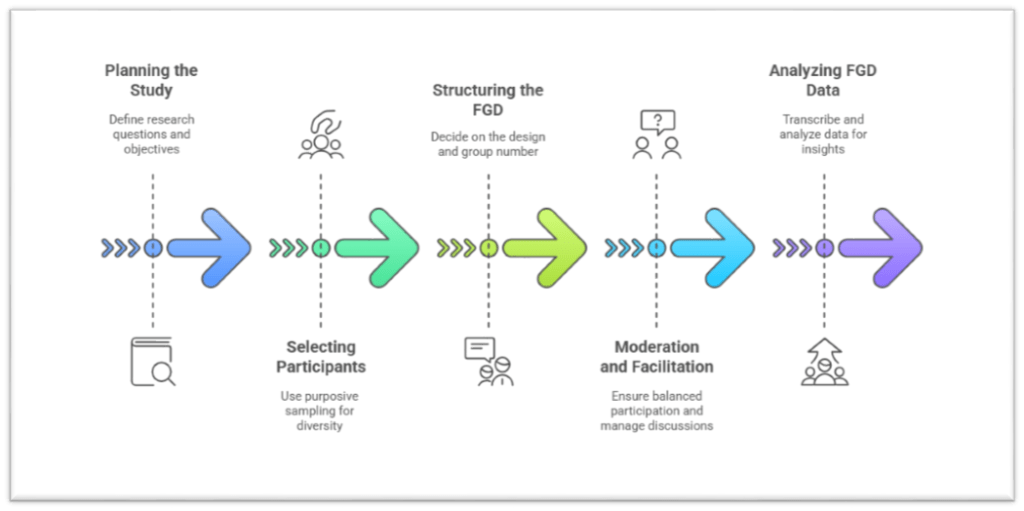
Running an effective FGD involves five key steps:
- Planning – Define research objectives, identify required information, and select appropriate participant groups. This stage also involves deciding on the number of FGDs needed to achieve data saturation.
- Participant Selection – Use purposive sampling to ensure diversity and confirm attendance in advance. Careful selection of participants is crucial to ensure that the group represents the target population and can provide meaningful insights.
- Structuring the FGD – Choose a format (single-category, multiple-category, or broad-involvement) and plan for multiple groups to achieve data saturation. The discussion guide should be flexible enough to allow for spontaneous insights while staying focused on the research objectives.
- Moderation and Facilitation – Encourage open discussions, manage dominant speakers, and use 5W1H (Who, What, When, Where, Why, and How) questioning techniques. A skilled moderator ensures that all voices are heard and that the discussion remains productive.
- Data Analysis – Transcribe discussions using AI tools and apply content analysis to identify themes, patterns, and insights, often integrating qualitative and quantitative findings. Advanced software like NVivo or Atlas.ti can assist in organizing and analyzing large volumes of qualitative data.
Integrating FGDs in Mixed-Method Research
FGDs play a vital role in mixed-method research by adding qualitative depth to quantitative findings. They can be integrated at various stages, such as during exploratory research to refine survey tools or post-survey validation to provide context to statistical results. FGDs also enhance triangulation, ensuring multiple perspectives validate the research. To integrate FGDs effectively, researchers should align qualitative and quantitative components by designing discussion guides that match survey themes, selecting participants based on prior quantitative analysis, and using content analysis to identify patterns that support or contrast with numerical data. By combining FGDs with surveys or experiments, mixed-method research captures both measurable trends and nuanced human experiences, leading to more comprehensive and actionable insights. For example, in a study on healthcare access, FGDs can reveal barriers that surveys might not capture, such as cultural stigmas or logistical challenges.

Challenges and Best Practices in Conducting FGDs
While FGDs are highly effective, they come with challenges. These include managing group dynamics, ensuring participant comfort, and avoiding bias in moderation. To address these challenges, researchers should:
- Train moderators to remain neutral and facilitate balanced discussions.
- Create a safe and inclusive environment to encourage honest participation.
- Use a mix of open-ended and probing questions to elicit detailed responses.
- Ensure confidentiality to build trust among participants.
Additionally, logistical challenges such as scheduling, venue selection, and recording equipment should be carefully planned to ensure smooth execution.
Applications of FGDs Across Fields
FGDs have diverse applications across various fields:
- Healthcare: Understanding patient experiences, evaluating health interventions, and exploring barriers to care.
- Education: Assessing teaching methods, curriculum effectiveness, and student needs.
- Business and Marketing: Exploring consumer preferences, testing product concepts, and evaluating brand perceptions.
- Development Studies: Gauging community needs, assessing development programs, and understanding local challenges.
In each of these fields, FGDs provide a platform for stakeholders to voice their opinions, ensuring that research outcomes are grounded in real-world experiences.
Conclusion
FGDs are a powerful tool for field assessments, offering in-depth, participatory insights that complement quantitative data. Whether applied in agribusiness, labor rights research, policy evaluations, or community-based studies, FGDs deepen our understanding of human experiences and decision-making processes. When conducted effectively, they strengthen mixed-method research by providing the rich qualitative data needed for informed decision-making. By addressing challenges and following best practices, researchers can maximize the potential of FGDs to generate actionable insights that drive meaningful change. In an increasingly complex world, FGDs remain an indispensable tool for capturing the voices and perspectives that shape our understanding of social, economic, and policy issues.

 time2anlytics.com
Leave a comment