

In a world filled with uncertainty, whether it’s predicting the weather, understanding stock market behavior, or training AI models, Probability Theory is the invisible force powering decision-making. This fascinating branch of mathematics allows us to quantify uncertainty and make sense of randomness.
Let’s dive into the world of probability theory, starting from the basics and moving toward applications with real-world examples.
📘 1. What Is Probability Theory?
Probability Theory is a mathematical framework that deals with random phenomena. It provides tools to describe and analyze events or outcomes that are not deterministic but subject to chance.
“Probability is the measure of how likely an event is to occur.”
In simplest terms, it answers questions like:
- What is the chance of getting heads when flipping a coin?
- What is the likelihood of rain tomorrow?
- What’s the probability that a customer will click on an ad?
🎯 2. Key Concepts in Probability
Let’s break down the key terms you need to know.
a. Experiment
An operation or process that produces an outcome.
👉 Example: Rolling a die.
b. Sample Space (S)
The set of all possible outcomes.
👉 Example: For a six-sided die,
S = {1, 2, 3, 4, 5, 6}
c. Event
A subset of the sample space. It could be one outcome or a group of outcomes.
👉 Example: Getting an even number → E = {2, 4, 6}
d. Probability of an Event (P(E))
The likelihood that an event occurs, denoted by:

👉 Example: Probability of getting a 3 on a die

🎲 3. Types of Probability
a. Classical Probability
Based on logical reasoning and symmetry.
👉 Example: Tossing a fair coin:

b. Empirical (Statistical) Probability
Based on experimental data or past observations.
👉 Example: If it rained on 30 out of 100 days,

c. Subjective Probability
Based on personal belief or judgment.
👉 Example: A doctor may estimate a 90% recovery chance based on experience.
🔗 4. Basic Rules of Probability
a. Addition Rule
If A and B are two mutually exclusive events:

👉 Example: Probability of getting a 1 or a 6 on a die

b. Multiplication Rule
If A and B are independent events:

👉 Example: Tossing two coins. Probability both are heads:

c. Complement Rule

👉 Example: If the probability of rain is 0.7, then no rain is

📊 5. Conditional Probability
Conditional probability is the probability of event A given that event B has already occurred, denoted:

👉 Example: A student is selected at random. Let A = student is a girl, B = student passed. Then

🎰 6. Bayes’ Theorem
Bayes’ Theorem is a powerful tool for updating probabilities based on new evidence:

👉 Real-world use: In medical testing, Bayes’ theorem helps calculate the probability that a person has a disease given a positive test result, considering false positives.
💡 7. Real-Life Applications of Probability Theory
| Domain | Application Example |
|---|---|
| Healthcare | Diagnosing disease based on symptoms and test results |
| Finance | Portfolio risk modeling and option pricing |
| Marketing | Predicting customer churn or click-through rates |
| Weather Forecasting | Probability of rain or storms |
| Machine Learning | Probabilistic models like Naive Bayes, Hidden Markov Models |
| Sports Analytics | Win predictions and game strategy optimization |
🧠 8. Example Problem: Card Draw
What is the probability of drawing an Ace from a standard deck of 52 cards?
There are 4 Aces in a deck.

What is the probability of drawing a red card (Hearts or Diamonds)?
There are 26 red cards.

🧮 9. Common Probability Distributions
a. Bernoulli Distribution
- Two outcomes: success (1), failure (0)
- Used in binary events
b. Binomial Distribution
- Repeated Bernoulli trials
- Example: Tossing a coin 10 times
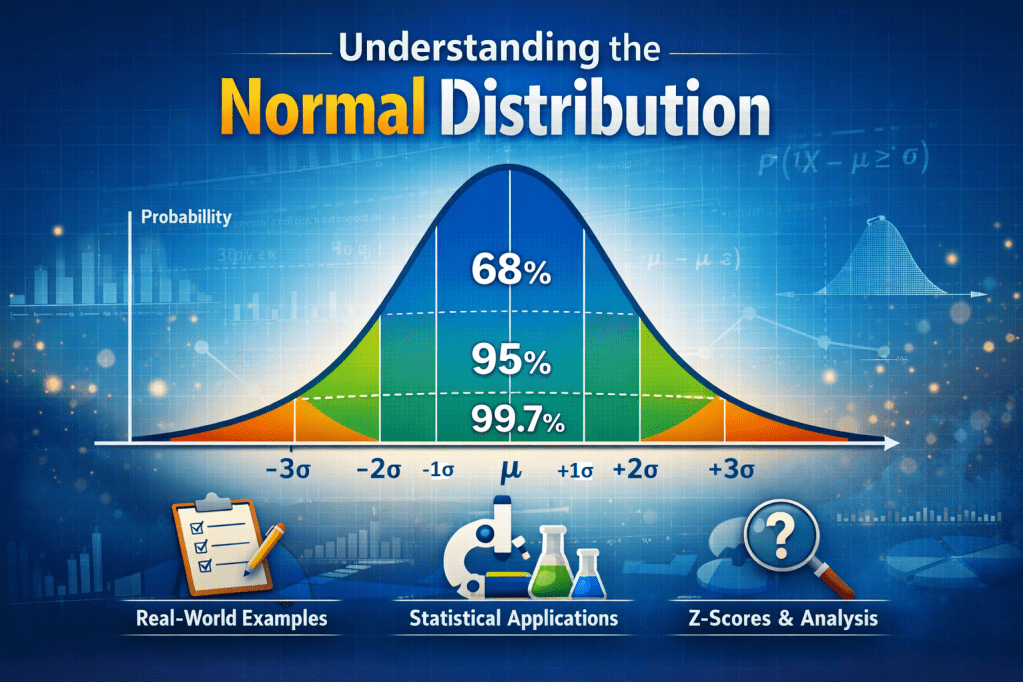
c. Normal Distribution
- Bell-shaped curve
- Many natural phenomena (e.g., heights, test scores) follow this
d. Poisson Distribution
- Models rare events in a fixed interval (e.g., number of emails per hour)
📌 10. Final Thoughts
Probability theory isn’t just about gambling or games—it’s a foundational pillar of data science, AI, risk management, and modern decision-making. Whether you’re designing algorithms or interpreting real-world uncertainties, understanding probability gives you a strategic edge in a world full of randomness.
📚 Further Reading
- Sheldon Ross. A First Course in Probability (Pearson)
- William Feller. An Introduction to Probability Theory and Its Applications
- Grinstead & Snell. Introduction to Probability
- Khan Academy – Probability & Statistics
- MIT OpenCourseWare – Introduction to Probability



 time2anlytics.com
Leave a comment