

A systematic roadmap for scientific inquiry
🌟 Introduction
Research is not just about collecting data or running statistical tests. It is about systematically answering a question using structured reasoning, evidence, and appropriate methods.
Whether in:
- Business analytics
- Social sciences
- Engineering
- Agriculture
- Finance
- Public policy
A well-designed research methodology ensures that findings are:
- Reliable
- Internally Valid
- Externally Generalizable
- Reproducible
- Scientifically defensible
In simple terms:
Research methodology is the blueprint of a research study.
Research methodology is the architecture that connects theory, data, and inference.
📌 What is Research Methodology?
Research methodology refers to the systematic framework that guides:
- Problem identification
- Data collection
- Analysis
- Interpretation
- Conclusion
It answers:
- What will you study?
- Why will you study it?
- How will you study it?
- What tools will you use?
- How will you validate your findings?
🧱 Components of Research Methodology
1️⃣ Research Problem Formulation
Everything starts with a clear research problem.
Good Research Questions:
- Specific
- Measurable
- Researchable
- Relevant
- Time-bound
📌 Example (Business Analytics):
How does dynamic pricing affect customer retention in online retail?
📌 Example (Agriculture Analytics):
Can satellite-derived vegetation indices predict crop yield variability in coffee plantations?
2️⃣ Literature Review
A literature review:
- Identifies knowledge gaps
- Avoids duplication
- Builds theoretical foundation
- Refines hypotheses
Sources:
- Peer-reviewed journals
- Working papers
- Policy reports
- Industry datasets
📌 Example:
Review studies on credit risk modeling before proposing a new IRB-based ML approach.
3️⃣ Research Objectives and Hypotheses
Objectives
Broad goals of the study.
Hypotheses
Testable statements.
Example:
H0 : There is no relationship between service quality and customer retention
H1 : Service quality positively impacts customer retention
4️⃣ Research Design
Research design is the overall structure of the study.
Types of Research Design
| Type | Purpose |
|---|---|
| Exploratory | Discover patterns |
| Descriptive | Describe characteristics |
| Explanatory | Test cause-effect |
| Experimental | Establish causality |
| Observational | Study without intervention |
📌 Example:
- Survey-based study → Descriptive
- A/B testing → Experimental
- Regression analysis → Explanatory
5️⃣ Data Collection Methods
Primary Data
Collected directly:
- Surveys
- Interviews
- Experiments
- Field observations
Secondary Data
Existing sources:
- Government databases
- Company records
- World Bank datasets
- Financial reports
📌 Example:
Using RBI banking statistics for credit risk analysis.
6️⃣ Sampling Techniques
Sampling ensures representation.
Probability Sampling
- Simple Random
- Stratified
- Cluster
Non-Probability Sampling
- Convenience
- Judgment
- Snowball
📌 Example:
Stratified sampling of farmers across districts.
7️⃣ Measurement and Instrument Design
Key considerations:
- Reliability
- Validity
- Scaling
Common scales:
- Likert scale
- Semantic differential
- Nominal/ordinal/interval/ratio scales
📌 Example:
Service quality measured using 5-point Likert scale.
8️⃣ Data Analysis Techniques
Depends on research objective.
Quantitative Methods
- t-test
- ANOVA
- Regression
- Chi-square
- Machine learning models
Qualitative Methods
- Thematic analysis
- Content analysis
- Case study analysis
📌 Example:
Using logistic regression to predict loan default probability.
9️⃣ Validity and Reliability
Reliability
Consistency of results.
Validity
Accuracy of measurement.
Types of validity:
- Internal validity
- External validity
- Construct validity
🔟 Interpretation and Reporting
Data must be interpreted in context.
Important:
- Avoid overstating results
- Acknowledge limitations
- Suggest future research
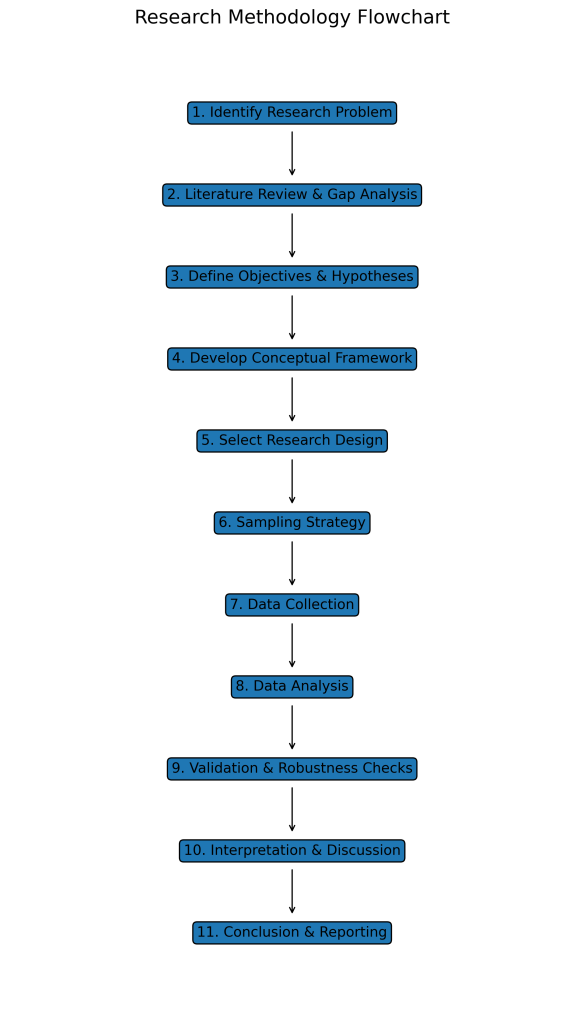
🧱 Elements of Research Methodology Framework
1️⃣ Philosophical Foundations of Research
Before methods, there is philosophy. Every research design implicitly rests on assumptions about:
- Ontology – What is reality?
- Epistemology – How do we know what we know?
- Methodology – How should we investigate?
Major Research Paradigms
| Paradigm | Assumption | Typical Methods |
|---|---|---|
| Positivism | Objective reality | Quantitative, experiments |
| Interpretivism | Subjective reality | Qualitative, interviews |
| Pragmatism | Problem-driven | Mixed methods |
📌 Example:
Credit risk modeling assumes a positivist approach (objective measurable risk), while consumer behavior studies may adopt interpretivist approaches.
2️⃣ Problem Formulation and Research Gap Identification
A research problem must:
- Address a theoretical gap
- Address a practical relevance
- Be feasible in terms of data and time
Research Gap Types
- Methodological gap (new method needed)
- Empirical gap (new dataset)
- Theoretical gap (conceptual framework lacking)
- Contextual gap (different geography/sector)
📌 Example:
Most IRB studies focus on developed economies. A contextual gap may exist for emerging markets.
3️⃣ Conceptual Framework Development
A conceptual framework links variables logically.
Example (Digital Finance Study):
Independent Variables:
- Digital adoption
- Financial literacy
Dependent Variable:
- Profitability
Control Variables:
- Firm size
- Industry type
Mathematically:
This ensures:
- Theoretical grounding
- Clear causal pathways
4️⃣ Research Design – Advanced View
Research design determines causal identification strategy.
A. Experimental Design
- Randomized Controlled Trials (RCT)
- A/B testing
- Laboratory experiments
Strength: High internal validity
Limitation: External validity concerns
B. Quasi-Experimental Design
- Difference-in-Differences (DiD)
- Regression Discontinuity
- Propensity Score Matching
Used when randomization is not feasible.
C. Observational Design
- Cross-sectional studies
- Longitudinal studies
- Panel data analysis
5️⃣ Sampling Theory and Representativeness
Sampling is not just selection—it affects inference.
Sampling Error
Difference between sample statistic and population parameter.
Central Limit Theorem
Ensures sampling distribution approximates normality for large n.
Advanced Considerations:
- Sample size determination (power analysis)
- Non-response bias
- Sampling frame adequacy
📌 Example:
In MSME surveys, under-representation of rural firms may bias results.
6️⃣ Measurement Theory and Scaling
Measurement must ensure:
- Reliability (consistency)
- Validity (accuracy)
Types of Validity
- Content validity
- Construct validity
- Criterion validity
- Convergent validity
- Discriminant validity
Reliability Measures
- Cronbach’s Alpha
- Test-retest reliability
- Inter-rater reliability
7️⃣ Data Analysis Strategy
Method selection depends on:
- Data type
- Hypothesis structure
- Distribution assumptions
A. Parametric Methods
- t-test
- ANOVA
- Regression
- Logistic regression
Assumptions:
- Normality
- Homoscedasticity
- Independence
B. Non-Parametric Methods
- Mann–Whitney test
- Kruskal–Wallis
- Spearman correlation
Used when assumptions fail.
C. Econometric Methods
- Panel regression
- Fixed effects
- Instrumental variables
Useful in policy research.
D. Machine Learning Methods
- Decision Trees
- Random Forest
- SVM
- Neural Networks
Focus:
- Prediction accuracy
- Cross-validation
- Overfitting prevention
8️⃣ Model Validation and Robustness
Modern research requires robustness checks:
- Sensitivity analysis
- Out-of-sample validation
- Cross-validation
- Bootstrapping
- Multicollinearity diagnostics
📌 Example:
In credit risk modeling, back-testing ensures PD estimates align with realized defaults.
9️⃣ Causality vs Correlation
A critical distinction.
Correlation:
Causation requires:
- Temporal precedence
- Control of confounders
- Theoretical plausibility
🔟 Ethical and Reproducible Research
Modern research must ensure:
- Data transparency
- Reproducible code
- Ethical clearance (IRB boards)
- No p-hacking
- Proper citation
Open science practices:
- Git repositories
- Pre-registration
- Data sharing
📊 Integrated Applied Example (Advanced)
Research Topic:
AI-based credit scoring impact on default prediction accuracy.
Design:
- Panel data of 5 years
- Compare traditional logistic regression vs ML model
Method:
- Train models
- Compute AUC, Precision, Recall
- Test statistical difference using DeLong test
Finding:
ML improves AUC from 0.72 → 0.84 (statistically significant).
🧮 Example: End-to-End Research Methodology (Applied Example)
Topic:
Impact of Digital Payment Adoption on MSME Profitability
Steps:
- Research Question
Does digital payment adoption improve MSME profitability? - Hypothesis
H₁: Digital adoption positively impacts profit margins. - Data
Survey of 300 MSMEs. - Method
Multiple regression:- Profit = β0 + β1 Digital Adoption + β2 Firm Size + ϵ
- Result
β₁ = 0.12 (p < 0.05) - Conclusion
Digital adoption significantly improves profitability.
🔄 Quantitative vs Qualitative Research
| Feature | Quantitative | Qualitative |
|---|---|---|
| Data Type | Numerical | Textual |
| Tools | Statistical models | Interviews |
| Sample Size | Large | Small |
| Outcome | Generalizable | Deep insights |
⚖️ Ethical Considerations in Research
- Informed consent
- Confidentiality
- Avoid plagiarism
- Avoid data manipulation
- Transparent reporting
🧠 Research in the Era of Big Data & AI
Modern research includes:
- Machine learning
- Big data analytics
- Remote sensing
- Real-time dashboards
- Experimental design with algorithms
Example:
Using satellite imagery + ML for yield prediction research.
🧾 Common Mistakes in Research Methodology
❌ Poorly defined research question
❌ Biased sampling
❌ Ignoring assumptions of statistical tests
❌ Overfitting models
❌ Confusing correlation with causation
❌ Lack of robustness checks
🎯 Key Takeaways
✔ Research methodology is the backbone of scientific inquiry
✔ Clear problem formulation is critical
✔ Method must align with research objective
✔ Statistical tools must match data type
✔ Ethics and transparency are non-negotiable
📚 References & Further Reading
- Creswell, J. W. (2018). Research Design: Qualitative, Quantitative, and Mixed Methods Approaches.
- Saunders, M., Lewis, P., & Thornhill, A. (2019). Research Methods for Business Students.
- Bryman, A. (2016). Social Research Methods.
- Kothari, C. R. (2004). Research Methodology: Methods and Techniques.
- Hair, J. F., et al. (2019). Multivariate Data Analysis.
- Montgomery, D. C. (2017). Design and Analysis of Experiments.
- Gujarati, D. N. (2015). Basic Econometrics.



 time2anlytics.com
Leave a comment