
Advanced credit risk measurement under Basel norms
🌟 Introduction
Credit risk—the risk that borrowers may fail to meet their obligations—is the largest risk faced by banks. To ensure banks hold sufficient capital against credit risk, global regulators introduced standardized and advanced risk measurement frameworks under the Basel Accords.
One of the most sophisticated of these is the Internal Ratings-Based (IRB) Approach, which allows banks to use their own internal credit risk models—subject to regulatory approval—to estimate capital requirements.
The IRB approach represents a shift from rule-based regulation to risk-sensitive, data-driven supervision.
📌 What Is the IRB Approach?
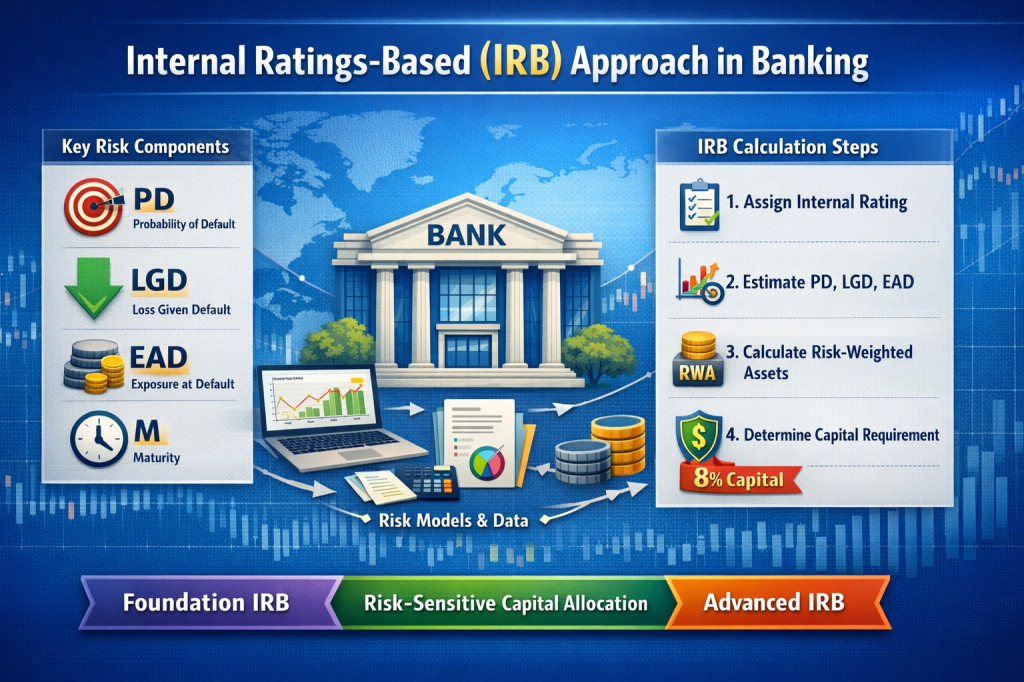
The Internal Ratings-Based (IRB) Approach is a method under the Basel framework that allows banks to estimate key credit risk parameters internally and use them to calculate Regulatory Capital for Credit Risk.
Under IRB, banks estimate:
- PD (Probability of Default)
- LGD (Loss Given Default) (in some cases)
- EAD (Exposure at Default) (in some cases)
- M (Effective Maturity)
These inputs are plugged into Basel-specified risk-weight functions to compute Risk-Weighted Assets (RWA).
🧱 Evolution of the IRB Approach
The IRB approach was formally introduced under:
- Basel II – Advanced credit risk measurement
- Strengthened under Basel III – Higher capital quality, buffers, and model governance
It is governed globally by the Basel Committee on Banking Supervision, operating under the Bank for International Settlements.
🧭 Types of IRB Approaches
1️⃣ Foundation IRB (F-IRB)
- Bank estimates: PD
- Regulators provide: LGD, EAD, M
📌 Suitable for banks transitioning from standardized approaches.
2️⃣ Advanced IRB (A-IRB)
- Bank estimates: PD, LGD, EAD, M
- Requires highly sophisticated risk systems
📌 Used by large, internationally active banks.
🧮 Key Credit Risk Components in IRB
🔹 Probability of Default (PD)
- Likelihood that a borrower defaults within 1 year
- Estimated using internal rating models
📌 Example:
A corporate borrower rated “BBB” has
PD = 1.5%
🔹 Loss Given Default (LGD)
- Percentage of exposure lost if default occurs
- Depends on collateral, seniority, recovery rates
📌 Example:
Secured loan → LGD = 40%
Unsecured loan → LGD = 60%
🔹 Exposure at Default (EAD)
- Amount outstanding at the time of default
- Includes drawn + expected future drawings
📌 Example:
Loan limit = ₹10 crore
Drawn = ₹7 crore
Estimated EAD = ₹8.5 crore
🔹 Maturity (M)
- Remaining economic maturity of exposure
- Impacts capital requirement for long-term loans
🔄 IRB Credit Risk Calculation Flow
Flow:
- Internal borrower rating
- PD estimation
- LGD & EAD estimation
- Basel risk-weight function
- RWA calculation
- Capital requirement (8% of RWA)
📊 Worked Example: IRB Capital Calculation
Assumptions (Corporate Loan):
- Exposure (EAD) = ₹100 crore
- PD = 2%
- LGD = 45%
- Maturity = 2.5 years
Using Basel’s IRB formula (simplified):
Expected Loss (EL) = PD × LGD × EAD
EL = 0.02 × 0.45 × 100 = ₹0.9 crore
The Basel risk-weight function converts PD, LGD, and M into Risk-Weighted Assets (RWA).
If:
RWA = ₹80 crore
Then minimum capital required:
Capital = 8% × 80 = ₹6.4 crore
📌 IRB typically produces more risk-sensitive capital than standardized methods.
📈 Benefits of the IRB Approach
✔ Risk-sensitive capital allocation
✔ Better differentiation between good and bad borrowers
✔ Encourages improved data, analytics, and governance
✔ Aligns regulatory capital with economic risk
⚠️ Challenges and Risks of IRB
✘ Model risk and estimation errors
✘ Data quality and historical depth requirements
✘ Procyclicality (capital rises in downturns)
✘ Regulatory scrutiny and approval complexity
✘ High implementation and maintenance cost
🏛️ Regulatory Oversight and Governance
Supervisors require banks to demonstrate:
- Robust model validation
- Independent risk governance
- Back-testing and stress testing
- Clear use-test (models used in business decisions)
In India, IRB adoption is overseen by the Reserve Bank of India, which has taken a cautious and phased approach.
🔍 IRB vs Standardized Approach
| Aspect | Standardized | IRB |
|---|---|---|
| Risk sensitivity | Low | High |
| Data requirement | Low | Very high |
| Regulatory approval | Not required | Mandatory |
| Model usage | None | Extensive |
| Capital efficiency | Lower | Potentially higher |
🌍 Real-World Use Cases
- Corporate & SME lending
- Retail credit (home loans, credit cards)
- Project finance
- Wholesale banking portfolios
Large global banks in Europe and the US primarily use Advanced IRB for major portfolios.
🔮 Post-Basel III & Basel IV Developments
- Reduced model flexibility (output floors)
- Constraints on IRB for certain asset classes
- Greater emphasis on stress testing
- Increased transparency and comparability
📌 Regulators aim to balance risk sensitivity with simplicity.
🔁 IRB vs Expected Credit Loss (ECL) under IFRS 9
Regulatory capital vs accounting impairment
Although both the Internal Ratings-Based (IRB) approach and Expected Credit Loss (ECL) under IFRS 9 rely on similar credit risk concepts (PD, LGD, EAD), their objectives and usage are fundamentally different.
- IRB → Regulatory capital adequacy
- IFRS 9 ECL → Financial reporting and loan loss provisioning
Understanding this distinction is crucial for bankers, risk managers, auditors, and analysts.
🎯 Purpose: Why They Exist
| Framework | Primary Purpose |
|---|---|
| IRB (Basel) | Ensure banks hold sufficient regulatory capital to absorb unexpected losses |
| IFRS 9 (ECL) | Ensure timely recognition of expected credit losses in financial statements |
📌 Key insight:
IRB focuses on unexpected loss (capital buffer), while IFRS 9 focuses on expected loss (provisions).
🧮 Core Risk Parameters: Similar Inputs, Different Use
Both frameworks use:
- PD (Probability of Default)
- LGD (Loss Given Default)
- EAD (Exposure at Default)
But they differ in time horizon and treatment.
| Aspect | IRB | IFRS 9 ECL |
|---|---|---|
| PD Horizon | 12-month PD | 12-month or Lifetime PD |
| LGD | Downturn LGD | Point-in-time LGD |
| EAD | Regulatory estimate | Accounting estimate |
| Forward-looking info | Limited | Mandatory (macroeconomic scenarios) |
📆 Time Horizon Difference (Very Important)
🔹 IRB
- Uses 1-year PD for capital calculation
- Focused on through-the-cycle risk
- Less sensitive to short-term economic fluctuations
🔹 IFRS 9
- Uses a staging approach:
| Stage | Credit Quality | Loss Recognition |
|---|---|---|
| Stage 1 | Performing | 12-month ECL |
| Stage 2 | Significant credit deterioration | Lifetime ECL |
| Stage 3 | Credit-impaired | Lifetime ECL + interest on net basis |
📌 IFRS 9 is much more forward-looking and procyclical.
📊 Numerical Example: IRB vs IFRS 9
Loan details:
- EAD = ₹100 crore
- PD (12-month) = 2%
- LGD = 45%
🔹 Expected Credit Loss (IFRS 9 – Stage 1)
ECL = PD × LGD × EAD
ECL = 0.02 × 0.45 × 100 = ₹0.9 crore
➡ Recognized as provision in P&L
🔹 IRB Capital Treatment
- Expected Loss (EL) = ₹0.9 crore
- Unexpected Loss → converted into Risk-Weighted Assets (RWA)
- Capital required = 8% of RWA
📌 EL is not expensed, but absorbed through provisions and capital buffers.
🏦 Accounting vs Regulatory Treatment
| Dimension | IRB | IFRS 9 |
|---|---|---|
| Framework type | Regulatory | Accounting |
| Governing body | Basel Committee | International Accounting Standards Board |
| Affects | Capital Adequacy Ratio | Profit & Loss |
| Volatility | Lower | Higher |
| Macro sensitivity | Low | High |
⚖️ Procyclicality: A Key Policy Concern
- IFRS 9 increases provisions sharply during downturns
- IRB smooths risk through long-term averages
📌 This can create tension:
- Higher ECL → lower profits
- Higher risk → higher capital requirements
Banks must manage capital + provisioning simultaneously.
🔄 Alignment Challenges for Banks
Banks face challenges in aligning:
- IRB PD models (through-the-cycle)
- IFRS 9 PD models (point-in-time)
- Data consistency
- Model governance and validation
- Regulatory vs audit expectations
📌 Many banks maintain parallel model frameworks.
🧠 Role of Analytics & AI
Advanced analytics helps by:
- Translating TTC PDs into PIT PDs
- Scenario-based ECL estimation
- Stress testing capital and provisions together
- Improving explainability for regulators and auditors
🧾 Key Takeaways
- IRB is a data-driven, advanced credit risk framework
- Relies on PD, LGD, EAD, and M
- Enables more accurate capital allocation
- Requires strong analytics, governance, and regulatory oversight
- Central to modern banking risk management
- IFRS 9 is more volatile and forward-looking
- Both IRB and IFRS 9 use PD, LGD, and EAD—but for different purposes
- IRB protects the system via capital buffers
- IFRS 9 protects transparency via early loss recognition
- Effective bank risk management integrates both frameworks
📚 References & Further Reading
- Basel Committee on Banking Supervision – Basel II & Basel III Credit Risk Framework
- Bank for International Settlements – Global Regulatory Standards
- Reserve Bank of India – Guidelines on Capital Adequacy
- International Monetary Fund – Financial Stability Reports
- Saunders & Allen – Credit Risk Management in and out of the Financial Crisis
- Hull, J. – Risk Management and Financial Institutions
- GARP – FRM Curriculum (Credit Risk)









Leave a comment