

The Complete Guide to SEO That Actually Grows Your Traffic
Authors: Beesu Sai Kumar , Chiranthana Prasad M. R. & Guruprasad Bhupali
The Bakery Nobody Could Find.
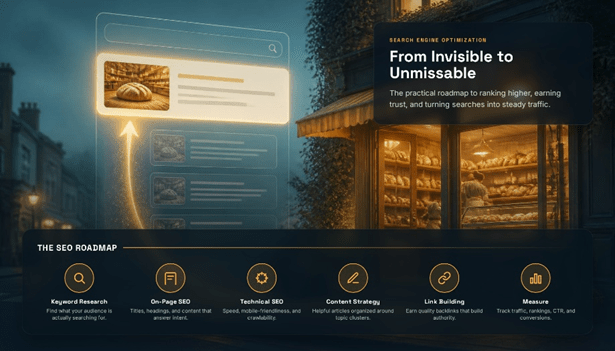
Priya opened her bakery on a quiet street corner three years ago. Her cinnamon rolls were, without exaggeration, the best in town. Regulars raved about them. Her Instagram was full of glowing comments. But when new customers searched “best bakery near me” on Google, her shop never showed up. Instead, a chain bakery two blocks away with mediocre pastries but a well-optimized website kept stealing the spotlight.
Frustrated, Priya finally asked a friend in digital marketing for help. The answer surprised her: it wasn’t her baking that needed work. It was her website’s relationship with search engines. Within a few months of making small, deliberate changes, her bakery started appearing on the first page of search results and foot traffic followed.
Priya’s story isn’t unique. It plays out every day for small businesses, bloggers, and brands who build something great but remain invisible online simply because search engines don’t understand or trust their content yet. That invisibility has a name, and so does the fix: Search Engine Optimization, or SEO.
In simple terms, SEO is the practice of shaping your website so that search engines can find it, understand it, and recommend it to the right people at the right moment. It matters because organic search is still one of the biggest sources of traffic for websites of every size, and unlike paid ads, the visibility you earn through SEO keeps working for you long after you’ve stopped actively promoting a page.
This guide walks through everything you need to know to go from invisible to unmissable: how search engines actually work, how to research the words your audience is typing, how to optimize your pages on-site and behind the scenes, how to build genuine authority through content and links, and how to measure whether any of it is working. Consider this your roadmap out of the digital shadows.
What Is SEO?
At its core, SEO stands for Search Engine Optimization the process of improving a website so that search engines like Google can find it, understand what it’s about, and rank it favorably when someone searches for related information.
Think of a search engine as a librarian for the entire internet. Every day, that librarian sends out little robots (called crawlers or bots) to read websites, take notes, and file them away in a giant catalog. When someone walks up and asks a question, the librarian doesn’t have time to read every book in the library right then instead, it pulls from that catalog and hands over the pages it believes answer the question best.
SEO is simply the work of making your “book” easy for the librarian to read, easy to categorize correctly, and trustworthy enough to hand to the person asking. Pages that are technically sound, genuinely useful, and well-organized tend to rank higher in organic (unpaid) search results which is the traffic SEO is trying to earn.
Why SEO Matters
- SEO isn’t a nice-to-have; it’s often the difference between a business that grows and one that stays invisible, no matter how good its product is.
- Increased traffic. Ranking well for the terms your audience searches put your website directly in front of people who are already looking for what you offer.
- Better visibility and credibility. Most people trust the top organic results more than paid ads, so ranking well builds an implicit sense of authority before a visitor even clicks.
- Long-term, compounding growth. Unlike ads that stop the moment you stop paying, a well-optimized page can keep bringing in traffic for years.
- Stronger brand awareness. Showing up consistently for relevant searches keeps your brand top-of-mind in your niche.
- Lead generation and sales. Visitors arriving through search are often further along in their decision-making, which makes them more likely to convert.
- Put simply, SEO turns your website from a static brochure into a discovery engine that works around the clock.
How Search Engines Work
- To understand SEO, it helps to understand the three-step process search engines use behind the scenes: crawling, indexing, and ranking.
- Crawling. Search engines send out automated bots that follow links from page to page across the web, scanning content as they go.
- Indexing. What the bots find gets stored in a massive database the index along with signals about what each page is about.
- Ranking. When someone runs a search, the engine sorts through the relevant pages in its index and orders them by how well each one is likely to satisfy that specific query, using hundreds of signals like relevance, quality, and trustworthiness.
- Every SEO tactic from choosing the right keywords to fixing a slow-loading page ultimately exists to make one of these three stages go more smoothly in your favor.
Keyword Research
Keywords are the words and phrases people actually type into a search bar. Keyword research is the process of figuring out which of those phrases are worth targeting, based on what your audience is searching for, how often they search it, and how much competition exists for that term. Not all keywords serve the same purpose. It helps to think about search intent the reason behind the search:
- Informational keywords (e.g., “how does SEO work”) signal someone looking to learn something.
- Commercial keywords (e.g., “best SEO tools 2026”) signal someone comparing options before a decision.
- Transactional keywords (e.g., “buy SEO software”) signal someone ready to take action.
- Matching the right keyword to the right stage of the buyer’s journey and to the right page on your site is what separates traffic that converts from traffic that simply passes through.
Practical process:
- Identify audience problems and questions.
- Group related terms into topic clusters.
- Prioritize by intent, difficulty, and business value.
- Create pages that fully satisfy the target intent rather than briefly mentioning keywords.
On-Page SEO
On-page SEO covers everything you can directly control on a given page to help both search engines and visitors understand it better. Core elements include:
- Title tags the clickable headline shown in search results.
- Meta descriptions the short summary beneath the title that encourages a click.
- Headings (H1, H2, H3) structure content logically for readers and crawlers alike.
- URLs clean, descriptive URLs are easier to read and share.
- Internal links connect related pages so both users and search engines can navigate your site.
- Image alt text describes images for accessibility and helps search engines understand visual content.
Each of these elements gives search engines a clearer signal about what your page offers, while also making the page more usable and inviting for the human being reading it.
Technical SEO
Technical SEO covers the behind-the-scenes health of a website the plumbing that makes everything else possible. Even brilliant content can underperform if the technical foundation is weak.
Key areas include:
- Website speed faster pages keep visitors engaged and are favored in rankings.
- Mobile friendliness a majority of searches now happen on phones, so responsive design is essential.
- Crawlability making sure search engine bots can actually access and navigate your pages.
- Indexing ensuring important pages are eligible to appear in search results.
- XML sitemaps a map that helps search engines discover all your pages efficiently.
- Structured data code that gives search engines extra context, sometimes unlocking rich results like star ratings or FAQs.
A technically healthy website is simply easier for search engines to process and easier processing tends to translate into better rankings.
Content Strategy for SEO
Great SEO content starts with matching user intent genuinely solving the problem someone typed into that search bar, rather than just repeating a keyword. A strong content strategy typically includes:
- Writing helpful, original articles that answer real questions your audience is asking.
- Organizing content into topic clusters a central pillar page supported by related articles to build depth and authority around a subject.
- Updating older content regularly so it stays accurate, relevant, and competitive as search trends shift.
Readability matters as much as research. Content that’s well-organized, scannable, and genuinely original tends to earn both better rankings and more trust from readers.
Link Building
Backlinks are links from other websites pointing to yours, and they function like votes of confidence in the eyes of search engines the more relevant, trustworthy sites that link to you, the more authority your own site tends to build.
Safe and effective ways to earn backlinks include:
- Guest posting on reputable sites in your niche.
- Digital PR earning coverage or mentions from journalists and publications.
- Creating genuinely valuable resources, like original research or in-depth guides, that others want to reference.
- Building real relationships within your industry that naturally lead to mentions and links.
Quality matters far more than quantity. A handful of links from respected, relevant sites will do more for your rankings than hundreds of links from low-quality or unrelated sources.
Measuring SEO Performance
SEO is a long game, so it’s important to track the right metrics over time rather than reacting to short-term fluctuations. Metrics worth watching include:
- Organic traffic – visitors arriving through unpaid search results.
- Keyword rankings where your pages sit for target search terms.
- Click-through rate (CTR) – how often people click your result after seeing it.
- Bounce rate – how many visitors leave without engaging further.
- Conversions – how many visitors take a meaningful action, like signing up or purchasing.
- Backlinks – the quantity and quality of sites linking to yours.
Because search engines weigh consistency and trust built over months, SEO should be evaluated as a trend line, not a single snapshot.
Common SEO Mistakes
Even well-intentioned SEO efforts can backfire if they fall into a few common traps:
- Keyword stuffing cramming in keywords unnaturally, which hurts readability and can trigger penalties.
- Duplicate content repeating the same content across pages, which confuses search engines about what to rank.
- Poor site speed slow pages frustrate users and rank worse.
- Ignoring mobile users a poor mobile experience can quietly sink an otherwise solid site.
- Weak internal linking – missed opportunities to guide both users and crawlers through your content.
- Writing for search engines instead of people – the surest way to produce content that ranks briefly but never truly connects.
Avoiding these pitfalls is often just as valuable as any single optimization tactic.
The Future of SEO
SEO is evolving quickly. AI-generated summaries, voice search, and zero-click results where a searcher gets their answer directly on the results page without visiting a website are all reshaping how visibility works. User experience is also playing a bigger role than ever in how search engines evaluate a page.
Despite all this change, the core idea has stayed remarkably consistent: search engines exist to connect people with content that genuinely answers their questions. The formats and signals will keep shifting, but useful, trustworthy, well-crafted content remains the foundation everything else is built on.
Priya’s Bakery, Revisited
A year after that first conversation with her friend, Priya’s bakery ranks on the first page for “best bakery near me” and stays there. Nothing about her cinnamon rolls changed. What changed was that her website finally spoke the language search engines could understand: clear structure, fast load times, genuinely helpful content, and a growing trail of other sites vouching for her.
That’s really what SEO comes down to. It’s not a trick or a shortcut, it’s the combination of content quality, technical health, and consistent optimization, applied patiently over time. Get the keyword research right, build pages that serve real search intent, keep the technical foundation solid, and earn links the honest way, and search engines will do what they’re designed to do: put your work in front of the people already looking for it.
The businesses and creators who win at SEO aren’t necessarily the ones with the biggest budgets they’re the ones willing to keep showing up, keep improving, and keep asking the same question search engines are always asking: does this page truly help the person who came looking for an answer? Answer that consistently, and visibility follows.
References
- Google Search Central. (n.d.). SEO starter guide: The basics. Google for Developers. Retrieved August 7, 2026, from https://developers.google.com/search/docs/fundamentals/seo-starter-guide
- Ahrefs. (n.d.). Keyword research: The beginner’s guide. Retrieved August 7, 2026, from https://ahrefs.com/seo/keyword-research
- Dean, B. (2026). Link building strategies: The complete list. Backlinko. Retrieved August 7, 2026, from https://backlinko.com/link-building-strategies
Beginner’s Guide to SEO” (moz.com/beginners-guide-to-seo)
SEO Learning Roadmap” (learningseo.io)






Leave a Reply