

The Ad Auction Nobody Can Win on Price Alone
Authors: Y. Jeevan Reddy, Kirubha Harini A. M., Ravi Ramm G. & Suthiksha P.
Introduction
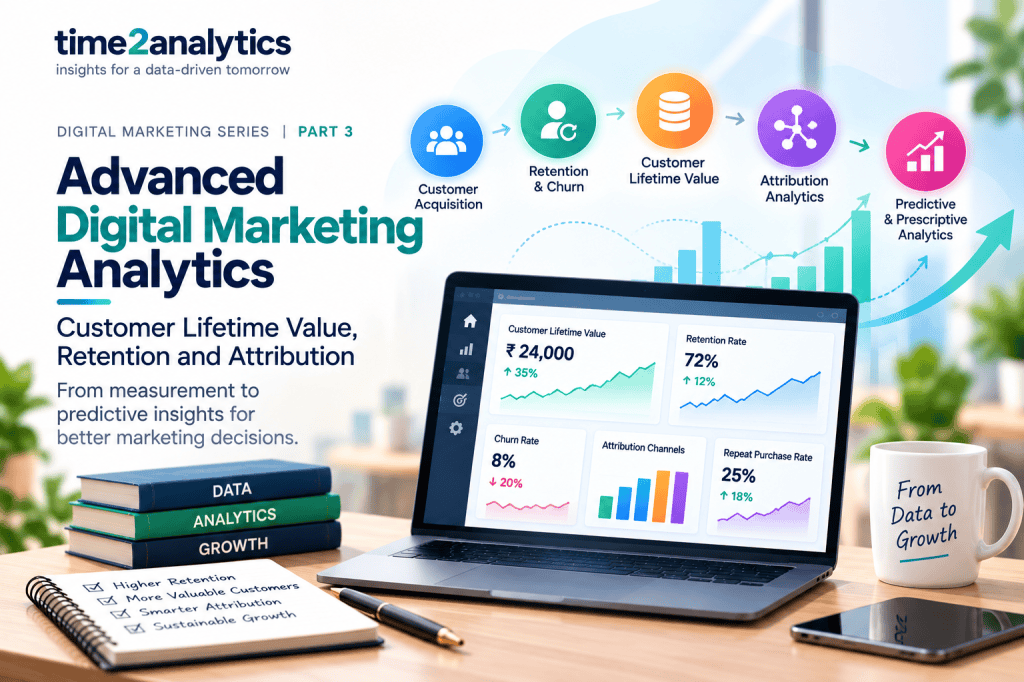
Digital marketing has transformed the way businesses engage with consumers by enabling real-time, personalized, and data-driven interactions across platforms such as search engines, social media, email, websites, and mobile applications. Unlike traditional marketing, where success was often measured through broad estimates, digital marketing allows organizations to track customer behavior at every stage of the buying journey using measurable metrics. This shift has placed greater emphasis on analytics, performance measurement, and return on investment (ROI), making it essential for marketers to understand not only how to attract customers but also how to retain and maximize their long-term value.
Customer Lifetime Value (CLV) has quietly become one of the most important numbers in digital marketing. As acquisition costs climb across Meta, Google, and TikTok, brands can no longer rely on cheap clicks or gut instinct to grow profitably. CLV gives marketers a data-backed way to understand exactly how much a customer is worth over the entire course of their relationship with a brand. Armed with that number, teams can make sharper decisions about how much to spend on acquisition, which channels to scale, and which customers deserve the most attention. In short, it’s the metric that turns digital advertising from a guessing game into a repeatable, profitable growth engine.
Picture two brands bidding on the exact same customer, in the exact same ad auction, at the exact same moment. One brand knows it can spend $40 to acquire that customer and still come out ahead. The other is guessing. Who do you think wins that auction, every single time?
This isn’t a hypothetical. It’s the reality of digital advertising in 2026. iOS privacy changes, cookie deprecation, and brutal competition for the same eyeballs on Meta, Google, and TikTok have pushed Customer Acquisition Cost (CAC) higher, year after year, across nearly every category. Cheap clicks are gone. What’s left is an auction where the deepest, most confident bidder takes the customer home.
And confidence, in this game, comes down to one rule: whoever can profitably afford to pay the most to acquire a customer wins the category.
The word “profitably” is doing all the work in that sentence. Outspending competitors is easy; any business can burn cash on ads. Outspending them and still turning a profit is the hard part, and it’s only possible if you know exactly what a customer is worth to you over time. That number has a name: Customer Lifetime Value, or CLV. Marketers who treat it as their north star stop asking “how cheap can we get this click” and start asking the only question that actually builds a business “how much is this relationship going to be worth?”
Cracking Open the Formula
Here’s the good news: CLV isn’t some black-box data-science metric locked away in a BI dashboard. It’s three numbers you probably already have, multiplied together.
CLV = Average Order Value (AOV) × Purchase Frequency × Customer Lifespan
Break it apart and each piece is intuitive:
- Average Order Value (AOV) what a customer typically spends per transaction. Four orders totaling $200 means an AOV of $50.
- Purchase Frequency how often that customer buys in a given year. Order six times a year, and frequency is 6.
- Customer Lifespan how many years that customer keeps coming back before they churn for good.
Put a real customer into the formula and the payoff becomes obvious. Someone who spends $50 an order, orders six times a year, and sticks around for three years is worth:
$50 × 6 × 3 = $900
That $900 isn’t just a nice number to admire, it’s the ceiling on what you can afford to spend acquiring that same kind of customer again. (Ceiling, not floor. We’ll come back to why margin matters in a moment.)
The Golden Ratio That Tells You Everything
Knowing CLV is only half the story. The real diagnostic tool is comparing it against CAC and the ratio between the two tells you, in a single glance, whether your growth engine is healthy, broken, or coasting.
- 1:1 Red alert. You’re spending exactly what the customer is worth in revenue, before accounting for the cost of goods, fulfillment, support, and overhead. In practice, this almost always means you’re losing money on every single customer.
- 3:1 The sweet spot. This is the widely cited industry benchmark for a healthy, sustainable acquisition engine. Every $1 spent returns $3 in lifetime value enough to cover costs, reinvest in growth, and still bank a profit.
- 5:1 or higher Playing it too safe. Counterintuitively, this isn’t always a win. It usually means the marketing budget is too conservative, and a bolder competitor willing to spend closer to 3:1 could out-acquire you for the same customers.
This is why CLV: CAC deserves to sit next to revenue and profit on the executive dashboard. It’s not a vanity metric it’s the dial that tells you whether to hit the gas or tap the brakes on spend.
Turning the Formula into a Playbook
Theory is nice, but growth teams live and die by tactics. Since CLV has exactly three levers AOV, frequency, and lifespan every tactic you run should map back to moving one of them. Here’s what that looks like in practice, using two brands built for exactly this kind of playbook:
Lever 1: Make Each Order Bigger (AOV)
- Cross-sell what naturally belongs together. Someone buying protein bars is already primed for a protein-enriched trail mix or a bundled “high-protein snack pack” the cross-sell solves the same craving, so it reads as helpful, not pushy.
- Catch them at the moment of highest intent. Right after a customer buys classic instant coffee, a post-purchase offer for a limited-batch flavored variant or a premium single-origin blend lands while they’re still in a buying mindset.
- Bundle toward a threshold. “Buy 3 protein snack packs, save 15%” nudges a one-item shopper into a full basket.
Lever 2: Get Them Coming Back Faster (Frequency)
- Turn purchases into habits with subscriptions. Both products are consumables with a built-in reorder cycle. A “subscribe and save” plan, a monthly protein snack box, a recurring Bean Craft coffee delivery quietly converts a one-off buyer into a habitual one.
- Nudge before they even realize they’re low. A well-timed replenishment email says, three weeks after a Bean Craft coffee order brings the customer back without them lifting a finger.
- Reward the return, not just the first sale. Points-based loyalty programs that pay off on the 2nd, 3rd, and 4th purchase give customers a reason to keep choosing or The Bean Craft over a shelf full of lookalikes.
Lever 3: Make the Relationship Last (Lifespan)
- Stay useful between purchases. Recipes built around protein powder or brewing guides for coffee keep the brand relevant even when the customer isn’t actively shopping.
- Fix problems before they become churn. A damaged shipment or a taste complaint, handled fast, prevents the quiet kind of churn that never shows up as a complaint the customer just doesn’t come back.
- Sell an identity, not just a product. “High-performance snacking” for or “quality coffee, anywhere” for The Bean Craft gives customers a reason to stay loyal that has nothing to do with the next discount code.
Where Even Smart Teams Trip Up
Here’s the twist: understanding the formula doesn’t automatically protect you from misusing it. These are the mistakes that quietly undo all the work above.
- Confusing revenue with profit. AOV × Frequency × Lifespan gives you revenue per customer, not profit. Skip the gross-margin conversion, and you’ll systematically overestimate how much you can afford to spend on acquisition. A business can look CLV-healthy on paper while losing money on every order.
- Averaging away your best customers. Blend VIP repeat buyers with one-time bargain shoppers into a single average, and you lose the real story and likely under-invest in the customers worth the most while over-spending to chase the ones worth the least.
- Treating CLV as permanent. A cohort acquired during a heavy discount period rarely behaves like one acquired organically. Calculate CLV once and freeze it, and your budget decisions get staler by the month.
- Chasing CAC efficiency in isolation. Optimizing purely for the lowest CAC, without watching what happens to CLV, can quietly shrink the value of the customers you’re bringing in; cheaper is sometimes cheaper because they’re lower-intent and quicker to churn.
- Letting it become a dashboard number, not a decision. The whole point of CLV is to change what you do next, which channels to scale, which segments to nurture, and how aggressively to bid. Reported and forgotten, it’s just trivia.
The North Star, Revisited
Go back to those two brands bidding in the same auction. The one that wins isn’t the one with the biggest budget or the flashiest creative, it’s the one that knows, to the dollar, what a customer is worth over their entire relationship with the brand, and bids with that confidence.
That’s the shift CLV asks marketers to make: stop optimizing for the cheapest click today, and start optimizing for the most valuable relationship over time. For brands like and The Bean Craft built on repeat consumption, subscriptions, and habits that shift isn’t just possible, it’s the whole growth strategy. Get the formula right, respect the ratio, avoid the traps, and CLV stops being a metric on a slide. It becomes the reason the business compounds instead of just surviving one ad cycle to the next.
Keywords
Customer Lifetime Value (CLV), Customer Acquisition Cost (CAC), CLV: CAC Ratio, Digital Advertising, Customer Retention
References
- First Page Sage. (2025). The LTV-to-CAC Ratio Benchmark. Retrieved from https://firstpagesage.com/seo-blog/the-ltv-to-cac-ratio-benchmark/
- Prefinery. (2025). CLV to CAC Ratio: Guide and Benchmarks. Retrieved from https://www.prefinery.com/blog/clv-to-cac-ratio-guide-and-benchmarks-2024/
- Userpilot. (2026). Average Customer Acquisition Cost (CAC) Industry Benchmarks. Retrieved from https://userpilot.com/blog/average-customer-acquisition-cost/
- EasyAppsEcom. (2026). Shopify Customer Acquisition Cost Benchmarks: CAC by Channel and Industry. Retrieved from https://easyappsecom.com/guides/shopify-customer-acquisition-cost-benchmarks Kontrol Media Consultancy. (2026). DTC Customer Acquisition Strategies That Drive Growth in 2026. Retrieved from https://kontrolmedia




Leave a Reply